COMMUNISM AS DESTROYER
Communist Revolution and its totalitarian worship of the 'the Party' and demand for obediance or death is the greatest purveor of evil the world has known. In the early years of the Bolshevik revolution and consolodation of power in Russia, Hungary, Bulgaria, and the attempt to establish it in Spain in the 1930's, the true nature of collectivism is shown whether it is called socialism or communism or under whatever misnomer, it is evil that rules 'the party' and inspires a bloddletting without comparison.
Everywhere they make first for the clergy which has claim to the belief patterns of the target nation and the intellectuals who can challenge them with thought and reason, for reason and common sense must be suspended for anyone to desire an arbitratry authority over themselves and their nation.
Of all revolutionary systems, which throughout human history have been devised for the destruction of our civilized values, Communism is without doubt the most perfected, most efficient and most merciless.
In fact it represents the most advanced epoch of the world revolution, in whose postulates it therefore not only acts to destroy a definite political, social, economic or moral institution, but also simultaneously to declare null and void the Church as well as all cultural and Christian manifestations which represent our civilization.
All revolutionary currents have attacked Christianity in its different aspects with particular one-mindedness.
Communism, spawned from this same revolutionary stream of thought, seeks to banish Christianity for the purpose of causing it to vanish from the face of the earth, without even the slightest trace remaining.
The destructive fury of this satanic striving, which brings before the eyes of the world the most terrible pictures of terror and destruction which are possible to imagine, can only be based on the essence of Nihilism as the prelude to revolution, the most evil, hate-filled rejection of everything hitherto existing.
For otherwise, one would not be able to understand the indescribable insanity of its criminal acts and the spirit of destruction, of annihilation, of insult, of contradiction and of resistance by its leading personalities against everything free, and the fundamental features not only of Christianity but of religion in general.
The purpose of Communism, as we have seen in Russia and in the other lands where it has been introduced, is to enslave the people in their economic, political, social, and spiritual sense in order to make possible a minority rule through violence. From an international aspect, the goal cannot be clearer:
“To attain through violence world domination by an insignificant minority, which destroys the rest of humanity by means of materialism, terror and, if necessary, by death, completely indifferent to whether in the process the enormous majority of the population must be murdered.”
The urge to murder, which has characterised the leading Soviet personages and their satellites, is known well throughout the world. There are few, who upon learning of the bloody purges, which have been undertaken by the Marxists in Russia, will not be seized by shudders of horror. One needs only to recall a few details to fill the most stout hearts with fear and alarm.
“In its beginnings the Red Terror strove above all to exterminate the Russian Intelligentsia.” As proof of this assertion S.P. Melgunow affirms the following, in which he refers to the “Special Committees”, which appeared in Russia in the first period of the Social revolution and in similar form in every other revolutionized nation:
“The special committees are not organs of law, but of merciless extermination according to the decisions of the Communist Central Committee. The special committee is neither a commission of investigation nor a court of justice, but itself determines its own powers. It is an instrument of battle, which acts on the internal front of the civil war. It does not pardon whoever stands on the other side of the barricades, but kills them.
“It is not difficult to form ideas of how in reality this extermination proceeds, when in place of the nullified legal code only the revolutionary experience and conscience command. This conscience is subjective and experience allows complete free play to the will, which always, according to the position of the judge, takes on more or less furious forms.”
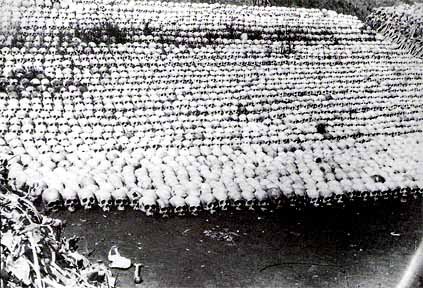
“Let us not carry on war against individual persons” – wrote Latsis – “but let us exterminate the Bourgeoisie as a class. Do not investigate, through study of documents and proofs, what the accused has done in words and deeds against the Soviet authority. The first question to be placed before him runs as to what class he belongs to, what is his origin, his education, his training and his profession.” This is exactly what befell the Cambodians after the Khmer Rouge came to poewer.
During the bloody dictatorship of Lenin, the Committee of Investigation under Rohrberg (Rohrberg, C.), which after the capture of Kiev entered this city with the White volunteers in August 1919, reported the following:
“The entire concrete floor of the large garage (this was the place where the provincial Cheka of Kiev had carried out executions) was swimming in blood, which did not flow but formed a layer of several inches; it was a grisly mixture of blood with brain and skull fragments, as well as strands of hair and other human remains. The entire walls, holed by thousands of bullets, were spattered with blood, and fragments of brain as well as head skin adhered to them.
“A drain ditch of 25 cm width and 25 cm deep and about 10 m long ran from the middle of the garage to a nearby room, where there was a subterranean outlet pipe. This drain ditch was filled to the top with blood.
“Usually, immediately after the massacre, the corpses were removed in lorries or horse-drawn wagons from the city and buried in a mass grave.
In the corner of a garden we came upon an older mass grave, which contained about 80 corpses, in which we discovered signs of the most varied and unimaginable cruelties and mutilation.
There were corpses from which the entrails had been removed; others had different limbs amputated and others again were cut into pieces. Some had had the eyes poked out, while the head, the face, the neck and the torso were covered with deep wounds. Further on we found a corpse with an axe in the breast, while others had no tongues. In a corner of the mass grave we discovered many legs and arms severed from the trunk.”
The enormous number of corpses, which have already been laid to the account of Communist Socialism and which increase terrifyingly all the while, will perhaps never be exactly known, but it exceeds everything imaginable. It is not possible to learn the exact number of the victims. All estimates lie below the real figure.”
In the Edinburgh newspaper “The Scotsman” of 7th November, 1923, Professor Sarolea gave the following figures in detailed description of how pervasive this evil machine was in carrying out its directive. You must ask yourselves, what kind of human being would carry out these crimes in such large scale?:
“28 Bishops; 1,219 priests; 6,000 Professors and teachers; 9,000 doctors; 54,000 Officers; 260,000 soldiers; 70,000 Policemen; 12,950 estate owners; 355,250 intellectuals and of the free professions; 193,290 tradesman and 215,000 peasants.”
The Information Committee of Denikin on the Bolshevistic intrigue during the years 1918-1919 records in a treatise about the Red Terror in these two years “one million, seven hundred thousand victims.” In the “Roul” of 3rd August 1923, Kommin makes the following observation:
“During the winter of 1920 there existed in the USSR, 52 governments with 52 Special Committees (Chekas), 52 Special Departments and 52 revolutionary courts. Besides countless subsidiary Chekas, transport-networks, courts on the railways as well as troops for internal security, there were mobile courts, which were dispatched to enforce mass executions in the places concerned.”
To this list of courts of torture must be added the special departments, i.e., 16 army and divisional courts. All in all one must there existed 1000's of torture chambers in which individual victims met deviates of the worst order. If it is borne in mind that at that time district committees also existed in addition, then the number rises further. In addition the number of governments of the USSR increased. Siberia, the Crimea and the Far East were conquered. The number of Chekas grew in geometrical ratio.
According to Soviet data (in the year 1920 when the terror had still not ebbed and the reporting of news was not restricted) it is possible to establish an average figure for every court; the curve of executions rises from one to fifty (in the great cities) and up to one hundred in the regions recently conquered by the Red Army.
The crisis of terror was periodic and then ceased; in this manner one can daily estimate the (modest) figure of five victims..., which, multiplied with the thousand courts, gives a result of five thousand, and thus for the year roughly one and a half million.
We recall this indescribable slaughter, not because in its totality it was either the most numerous or the most merciless to arise from the special situation and inflamed passions consequent on the first victories of the Bolshevist revolution, but because today, many years after these mass executions took place, all this might otherwise be obliterated from the present Communist picture, even for the persons who were contemporaries of the events and who today, if still alive, have forgotten those tragedies with the ease with which people forget not only unpleasant events which do not directly concern them, but even those to which they fell victim.
Unhappily, time has shown a truly demonic excess of Communism in its murderous activity. The monstrous statistics are known to all and several of these cruel bloodbaths have taken place recently and even continue in the conquered nations of Laos, Cambodia, and Viet Nam where the hill tribesman, Montagnard, and remnants of free Lao hide in the jungles, hunted like animals. One may hear today the lament of the persecuted, the death-rattle of the dying, and the terrible and haunting complaint of the corpses.
It may suffice to recall the giant bloodbaths in Hungary, Poland, East Germany and Cuba as well as the earlier mass killings by Stalin, the forced starvation of 5 million Ukranians, and the annihilation of millions of Chinese through the Communist regime of Mao-Tse-Tung and the millions more in the so called, 'Cultural Revolution' strewn with corpses.
But also the Communist attempts at revolution, which failed to achieve lasting permanence, such as that of Bela Kun who occupied Hungary in such a brutal way in the middle of 1919; of Spain in 1936, where the Bolsheviks gained control of Madrid and parts of the Spanish provinces and murdered 12 Bishops and more than 16,000 priests, monks and nuns; further the happily unsuccessful attempt in Germany, and in the Red Republic of Bavaria in the year 1919. All these attempts were orgies of torture and death in the manner of 1918 and which had bloodletting and unrestrained bestiality perpetrated on innocent victims.
This Apocalyptic storm, which brings a flood of corpses, blood and tears, and finally the peace of the cell, the shackle, and the grave falls upon the world with the sole goal: to destroy not only the Church but the entire Christian civilisation.
Before this shattering picture the world asks itself with heavy heart: who can hate our Christian features in such a form and try to destroy them with such Godless fury? Who has become capable of instigating this bloody mechanics of annihilation? Who can with such insensitivity direct and order this monstrous criminal process? And reality answers us completely without doubt that the [Bolshevik] are those responsible...
They now add to their rank of haters of all things Western and Christian, the Islamic Jihad. Together, with one goal, destruction of America, they need not be allies in the traditional sense.
Showing posts with label Jihad. Show all posts
Showing posts with label Jihad. Show all posts
Monday, November 17, 2008

Friday, November 7, 2008
Off With Their Heads
The Sacred Muslim Practice of Beheading
By Andrew G. Bostom
FrontPageMagazine.com May 13, 2004
"...and I saw the Souls of them that were beheaded for the witness of Jesus..." Revelation 20:4
Reactions to the grotesque jihadist decapitation of yet another "infidel Jew," Mr. Berg,
make clear that our intelligentsia are either dangerously uninformed, or simply unwilling to come to terms with this ugly reality: such murders are consistent with sacred jihad practices, as well as Islamic attitudes towards all non-Muslim infidels, in particular, Jews, which date back to the 7th century, and the Prophet Muhammad's own example.
According to Muhammad’s sacralized biography by Ibn Ishaq, Muhammad himself sanctioned the massacre of the Qurayza, a vanquished Jewish tribe. He appointed an "arbiter" who soon rendered this concise verdict: the men were to be put to death, the women and children sold into slavery, the spoils to be divided among the Muslims. Muhammad ratified this judgment stating that it was a decree of God pronounced from above the Seven Heavens.
Thus some 600 to 900 men from the Qurayza were lead on Muhammad’s order to the Market of Medina. Trenches were dug and the men were beheaded, and their decapitated corpses buried in the trenches while Muhammad watched in attendance.
Women and children were sold into slavery, a number of them being distributed as gifts among Muhammad’s companions, and Muhammad chose one of the Qurayza women (Rayhana) for himself. The Qurayza’s property and other possessions (including weapons) were also divided up as additional "booty" among the Muslims, to support further jihad campaigns.
The classical Muslim jurist al-Mawardi (a Shafi’ite jurist, d. 1058) from Baghdad was a seminal, prolific scholar who lived during the so-called Islamic "Golden Age" of the Abbasid-Baghdadian Caliphate. He wrote the following, based on widely accepted interpretations of the Qur'an and Sunna (i.e., the recorded words and deeds of Muhammad), regarding infidel prisoners of jihad campaigns:
“As for the captives, the amir [ruler] has the choice of taking the most beneficial action of four possibilities: the first to put them to death by cutting their necks; the second, to enslave them and apply the laws of slavery regarding their sale and manumission; the third, to ransom them in exchange for goods or prisoners; and fourth, to show favor to them and pardon them.
Allah, may he be exalted, says, 'When you encounter those [infidels] who deny [the Truth=Islam] then strike [their] necks' (Qur'an sura 47, verse 4)”....Abu’l-Hasan al-Mawardi, al-Ahkam as-Sultaniyyah." [The Laws of Islamic Governance, trans. by Dr. Asadullah Yate, (London), Ta-Ha Publishers Ltd., 1996, p. 192. Emphasis added.]
Indeed such odious “rules” were iterated by all four classical schools of Islamic jurisprudence, across the vast Muslim empire.
For centuries, from the Iberian peninsula to the Indian subcontinent, jihad campaigns waged by Muslim armies against infidel Jews, Christians, Zoroastrians, Buddhists and Hindus, were punctuated by massacres, including mass throat slittings and beheadings.
During the period of “enlightened” Muslim rule, the Christians of Iberian Toledo, who had first submitted to their Arab Muslim invaders in 711 or 712, revolted in 713. In the harsh Muslim reprisal that ensued, Toledo was pillaged, and all the Christian notables had their throats cut.
On the Indian subcontinent, Babur (1483-1530), the founder of the Mughal Empire, who is revered as a paragon of Muslim tolerance by modern revisionist historians, recorded the following in his autobiographical “Baburnama,” about infidel prisoners of a jihad campaign:
"Those who were brought in alive [having surrendered] were ordered beheaded, after which a tower of skulls was erected in the camp." [The Baburnama -Memoirs of Babur, Prince and Emperor, translated and edited by Wheeler M. Thacktson, Oxford University Press,1996, p. 188. Emphasis added.]
Recent jihad-inspired decapitations of infidels by Muslims have occurred across the globe- Christians in Indonesia, the Philippines, and Nigeria; Hindu priests and "unveiled" Hindu women in Kashmir; Wall Street Journal reporter, and Jew, Daniel Pearl.
We should not be surprised that these contemporary paroxysms of jihad violence are accompanied by ritualized beheadings. Such gruesome acts are in fact sanctioned by core Islamic sacred texts, and classical Muslim jurisprudence.
Empty claims that jihad decapitations are somehow "alien to true Islam," however well-intentioned, undermine serious efforts to reform and desacralize Islamic doctrine. This process will only begin with frank discussion, both between non-Muslims and Muslims, and within the Muslim community.
By Andrew G. Bostom
FrontPageMagazine.com May 13, 2004
"...and I saw the Souls of them that were beheaded for the witness of Jesus..." Revelation 20:4
Reactions to the grotesque jihadist decapitation of yet another "infidel Jew," Mr. Berg,
make clear that our intelligentsia are either dangerously uninformed, or simply unwilling to come to terms with this ugly reality: such murders are consistent with sacred jihad practices, as well as Islamic attitudes towards all non-Muslim infidels, in particular, Jews, which date back to the 7th century, and the Prophet Muhammad's own example.
According to Muhammad’s sacralized biography by Ibn Ishaq, Muhammad himself sanctioned the massacre of the Qurayza, a vanquished Jewish tribe. He appointed an "arbiter" who soon rendered this concise verdict: the men were to be put to death, the women and children sold into slavery, the spoils to be divided among the Muslims. Muhammad ratified this judgment stating that it was a decree of God pronounced from above the Seven Heavens.
Thus some 600 to 900 men from the Qurayza were lead on Muhammad’s order to the Market of Medina. Trenches were dug and the men were beheaded, and their decapitated corpses buried in the trenches while Muhammad watched in attendance.
Women and children were sold into slavery, a number of them being distributed as gifts among Muhammad’s companions, and Muhammad chose one of the Qurayza women (Rayhana) for himself. The Qurayza’s property and other possessions (including weapons) were also divided up as additional "booty" among the Muslims, to support further jihad campaigns.
The classical Muslim jurist al-Mawardi (a Shafi’ite jurist, d. 1058) from Baghdad was a seminal, prolific scholar who lived during the so-called Islamic "Golden Age" of the Abbasid-Baghdadian Caliphate. He wrote the following, based on widely accepted interpretations of the Qur'an and Sunna (i.e., the recorded words and deeds of Muhammad), regarding infidel prisoners of jihad campaigns:
“As for the captives, the amir [ruler] has the choice of taking the most beneficial action of four possibilities: the first to put them to death by cutting their necks; the second, to enslave them and apply the laws of slavery regarding their sale and manumission; the third, to ransom them in exchange for goods or prisoners; and fourth, to show favor to them and pardon them.
Allah, may he be exalted, says, 'When you encounter those [infidels] who deny [the Truth=Islam] then strike [their] necks' (Qur'an sura 47, verse 4)”....Abu’l-Hasan al-Mawardi, al-Ahkam as-Sultaniyyah." [The Laws of Islamic Governance, trans. by Dr. Asadullah Yate, (London), Ta-Ha Publishers Ltd., 1996, p. 192. Emphasis added.]
Indeed such odious “rules” were iterated by all four classical schools of Islamic jurisprudence, across the vast Muslim empire.
For centuries, from the Iberian peninsula to the Indian subcontinent, jihad campaigns waged by Muslim armies against infidel Jews, Christians, Zoroastrians, Buddhists and Hindus, were punctuated by massacres, including mass throat slittings and beheadings.
During the period of “enlightened” Muslim rule, the Christians of Iberian Toledo, who had first submitted to their Arab Muslim invaders in 711 or 712, revolted in 713. In the harsh Muslim reprisal that ensued, Toledo was pillaged, and all the Christian notables had their throats cut.
On the Indian subcontinent, Babur (1483-1530), the founder of the Mughal Empire, who is revered as a paragon of Muslim tolerance by modern revisionist historians, recorded the following in his autobiographical “Baburnama,” about infidel prisoners of a jihad campaign:
"Those who were brought in alive [having surrendered] were ordered beheaded, after which a tower of skulls was erected in the camp." [The Baburnama -Memoirs of Babur, Prince and Emperor, translated and edited by Wheeler M. Thacktson, Oxford University Press,1996, p. 188. Emphasis added.]
Recent jihad-inspired decapitations of infidels by Muslims have occurred across the globe- Christians in Indonesia, the Philippines, and Nigeria; Hindu priests and "unveiled" Hindu women in Kashmir; Wall Street Journal reporter, and Jew, Daniel Pearl.
We should not be surprised that these contemporary paroxysms of jihad violence are accompanied by ritualized beheadings. Such gruesome acts are in fact sanctioned by core Islamic sacred texts, and classical Muslim jurisprudence.
Empty claims that jihad decapitations are somehow "alien to true Islam," however well-intentioned, undermine serious efforts to reform and desacralize Islamic doctrine. This process will only begin with frank discussion, both between non-Muslims and Muslims, and within the Muslim community.
Wednesday, November 5, 2008
Jihad and Shaira Law
Jihad: http://www.youngmuslims.ca/online_library/books/jihad/index.htm
Preface
In the name of Allah, the Most Compassionate, the Most Merciful. Praise be to Allah, and may his peace and blessings be upon Muhammad and upon his household and companions, and all those who follow him.
The Muslim world today is faced with tyranny and injustice. Indeed oppression and hardship is not just limited to the Muslim world, rather many non-Muslim states are subject to oppression at the hands of the world’s leading military and economic powers. Anyone who cares can only be saddened and hurt by the pain and suffering that accompanies so many faces. Islam has allowed jihad as a means to prevent oppression, yet the Muslims have forgotten this for too long.
Though jihad may be a part of the answer to the problems of the ummah, it is an extremely important part. Jihad is to offer ourselves to Allah for His Cause. Indeed, every person should according to Islam prepare himself/herself for jihad and every person should eagerly and patiently wait for the day when Allah will call them to show their willingness to sacrifice their lives. We should all ask ourselves if there is a quicker way to heaven? It is with this in mind that this booklet is being published.
It may be asked of ourselves and others here as to why we remain in this country while there is so much opportunity for reward. It is our understanding that today’s problems does not require the one solution whether this be jihad, working for the khilafah, purifying ourselves etc. but rather our situation today requires action on all fronts. Everybody has a role to play in today’s great jigsaw, those who are attempting to establish the Islamic state have to continue doing so focusing their minds onto such a project, those who are faced with tyranny at the hands of neighbouring armies have to defend themselves with their lives and those that have the opportunity of giving Islam to the world should do so..
This is an important booklet for three reasons: firstly, it deals with an important issue - that of jihad. Secondly, it is important because it has been written by one of the most prominent Mujahideen of this century - Imam Hasan al-Banna, and thirdly it is important because it deals with an issue that the ummah seems to have misunderstood or forgotten.
Imam Hasan al-Banna is the founder of the Muslim Brotherhood and one of the pioneers of today’s Islamic revival. It is a shame that so many people are unaware of this man and his contribution towards what we see today. It is the right of the contemporary Muslim generation that they should have access to the writings of this great reformer; especially on this important topic.
The Imam, may Allah bless him, shows us that ultimately, and insha’Allah (God-willing) time will be a witness to this, only Islam can save mankind from itself. And jihad on the individual and international scale will be a necessary part of this process of change.
The Imam himself was assassinated in 1949, aged 43 years. It is a testimony to his character that Allah answered his duaa’ that he made at the end of this work. May Allah accept our efforts and may Allah similarly accept and answer our duaa’.
Dr A. M. A. Fahmy
International Islamic Forum
--------------------------------------------------------------------------------
In the Name of Allah, the Merciful, the Compassionate
All praise is for Allah, the Lord of the Universe. May Allah bestow peace and blessings upon our Leader Muhammad, Leader of those who strive in Allah's way and Imam of the pious. May He also bestow peace and blessings upon his family and his companions, and all those who strive for the Sharee’ah until the Day of Judgement.
All Muslims Must Make Jihad
Jihad is an obligation from Allah on every Muslim and cannot be ignored nor evaded. Allah has ascribed great importance to jihad and has made the reward of the martyrs and the fighters in His way a splendid one. Only those who have acted similarly and who have modelled themselves upon the martyrs in their performance of jihad can join them in this reward. Furthermore, Allah has specifically honoured the Mujahideen with certain exceptional qualities, both spiritual and practical, to benefit them in this world and the next. Their pure blood is a symbol of victory in this world and the mark of success and felicity in the world to come.
Those who can only find excuses, however, have been warned of extremely dreadful punishments and Allah has described them with the most unfortunate of names. He has reprimanded them for their cowardice and lack of spirit, and castigated them for their weakness and truancy. In this world, they will be surrounded by dishonour and in the next they will be surrounded by the fire from which they shall not escape though they may possess much wealth. The weaknesses of abstention and evasion of jihad are regarded by Allah as one of the major sins, and one of the seven sins that guarantee failure.
Islam is concerned with the question of jihad and the drafting and the mobilisation of the entire Umma into one body to defend the right cause with all its strength than any other ancient or modern system of living, whether religious or civil. The verses of the Qur'an and the Sunnah of Muhammad (PBUH) are overflowing with all these noble ideals and they summon people in general (with the most eloquent expression and the clearest exposition) to jihad, to warfare, to the armed forces, and all means of land and sea fighting.
We shall not go into exhaustive detail but rather will offer you some Qur'anic verses and Ahaadeeth below as examples since we only wish to show a glimpse of the Islamic message on jihad. Furthermore, we will not delve into the explanation of the Qur'anic verses or Ahaadeeth. You will recognise by the purity of language, the clarity of exposition, the lucidity of ideas and the force of spirituality that explanations and clarifications are not required.
The Qur’an on Jihad
‘Jihad is ordained for you (Muslims) though you dislike it, and it may be that you dislike something which is good for you and that you like something which is bad for you. Allah knows but you do not know.’
(Surat-al-Baqarah (2), ayah 216)
‘O you who believe! Be not like those who disbelieve (hypocrites) and who say to their brethren when they travel through the earth or go out to fight: 'If they had stayed with us, they would not have died or been killed,' so that Allah may make it a cause of regret in their hearts. It is Allah that gives life and causes death. And Allah is All-Seer of what you do. And if you are killed or die in the Way of Allah, forgiveness and mercy from Allah are far better than all that they amass (of worldly wealth etc.). And whether you die, or are killed, verily, unto Allah you shall be gathered.’
(Surat-aal-Imran (3), ayah 156-158)
Notice how "forgiveness" and "mercy" are associated with slaying and death in Allah's way in the first verse, and how the second verse is does not refer to this because it is devoid of the idea of jihad. In this verse, there is an indication of the fact that cowardice is one of the characteristics of unbelievers, but not of believers. And notice how today the unbelievers seem to be brave and the believers seem to be the cowards.
‘Think not of those who are killed in the Way of Allah as dead. Nay, they are alive, with their Lord, and they have provision. They rejoice in what Allah has bestowed upon them of His Bounty, rejoicing for the sake of those who have not yet joined them, but are left behind (not yet martyred) that on them no fear shall come, nor shall they grieve.’
(Surat-aal-Imran (3), ayah 169-170). Refer up to verse 175 for further information.
‘Let those (believers) who sell the life of this world for the Hereafter fight in the cause of Allah., and whosoever fights in the Cause of Allah, and is killed or is victorious, We shall bestow on him a great reward.’
(Surat-an-Nisaa’ (4), ayah 74)
Refer to the verses (4: 71-78) in the Noble Book to understand how Allah urges the Muslims to remain alert and to acquire experience in warfare, in armies and troops, or as individuals, as circumstances may dictate. Allah also reprimands those who are slack, cowards or opportunists, and He arouses our zeal to protect the weak and prevent oppression. Notice how Allah associates warfare with prayer and fasting, establishing it as one of the pillars of Islam. And how He refutes the false arguments of the waverers, and encourages those who are scared to the utmost degree to plunge into battle and to face death unflinchingly and bravely, showing them that they will welcome death, and that if they die in jihad, they will receive the most magnificent recompense for their lives, and that they will not lose any of their contribution or sacrifice however small.
Surat-al-Anfaal is in its entirety an exhortation to jihad and a command to remain steadfast [while engaged] in it, as well as a clear presentation of many of its rules. It is for this reason that the first Muslims (may Allah's grace be upon them) adopted it as a war chant which they would chant whenever their apprehensions mounted and the battle grew grim. Suffice it to quote what Allah (SWT) says:
‘Against them make ready your strength to the utmost of your power, including steeds of war, to strike terror into (the hearts of) the enemies of Allah and your enemies.’
(Surat-al-Anfaal (8), ayah 60)
up to His words (SWT):
‘O Prophet! Urge the believers to fight. If there are twenty steadfast amongst you, they will overcome two hundred, and if there are be a hundred steadfast they will overcome a thousand of those who disbelieve, because they (they disbelievers) are people who do not understand’
(Surat-al-Anfaal (8), ayah 65)
Surat-at-Tawbah too is in its entirety an exhortation to combat and a clear presentation of its rules. It is sufficient to quote what Allah (SWT) says concerning warfare against the treacherous polytheists:
‘Fight against them so that Allah will punish them by your hands and disgrace them and give you victory over them and return calmness in the hearts of the believing people thus relieving their anxiety. Allah accepts the repentance of whom He wills. Allah is All-Knowing, All-Wise.’
(Surat-at-Tawbah (9), ayah 14-15)
And His words (SWT) concerning fighting with People of the Book:
‘Fight against those who believe not in Allah nor in the Last Day, nor forbid that which has been forbidden by Allah and His Messenger and those who acknowledge not the Religion of Truth (i.e. Islam), from among the People of the Book, until they pay the jizya with willing submission, and feel themselves subdued.’
(Surat-at-Tawbah (9), ayah 29)
The proclamations of the general call in the following verses, end with His words (SWT):
‘March forth, (whether equipped) lightly or heavily, and strive hard with your wealth and your lives in the Cause of Allah! This is better for you, if you but knew.’
(Surat-at-Tawbah (9), ayah 41)
Allah then rebukes those who are cowardly for their attitude and their continuous attempts to escape from jihad, in His words (SWT):
‘Those who stayed away (from Tabuk expedition) rejoiced in their staying behind the Messenger of Allah; they hated to strive and fight with their wealth and their lives in the Cause of Allah, and they said, 'March not forth in the heat.' Say: 'The fire of Hell is more intense in heat,' if only they could understand!' So let them laugh a little (and they will) cry much as a recompense of what they used to earn (by committing sins). If Allah brings you back to a party of them, and they ask your permission to go out (to fight), say: 'Never shall you go out with me, nor fight an enemy with me: you agreed to sit inactive on the first occasion: then you sit (now) with those who lag behind.’
(Surat-at-Tawbah (9), ayah 81-83)
Then Allah praises those who engage in jihad by declaring jihad as Prophet Muhammad's mission and the way of his Companions, as He, the Almighty, says:
‘But the Messenger, and those who believed with him, strove hard and fought with their wealth and their lives (in Allah's cause). The good things are for these people, and it is they who will be successful. For them Allah has got ready the Gardens (Paradise) under which rivers flow, to dwell therein forever. That is the supreme success.’
(Surat-at-Tawbah (9), ayah 88-89)
Then follows an oath of allegiance, comprehensive and protective leaving no excuses, in His words (SWT):
‘Verily, Allah has purchased of the believers their lives and their wealth; for the price that theirs shall be the Paradise. They fight in Allah's Cause, so they kill (others) and are killed. It is a promise in truth which is binding on Him in the Torah and the Gospel and the Qur'an. And who is truer to his covenant than Allah? Then rejoice in the bargain which you have concluded. That is the supreme success.’
(Surat-at-Tawbah (9), ayah 111)
Surat-al-Qital (commonly known as Surat Muhammad) mentions two key factors that form the foundation of the military spirit: obedience and discipline. Allah has summarised these two factors in the following two verses in His Book. Obedience appears in this Surah where He, the Almighty, says:
‘Those who believe say: "Why is a Surah not sent down (for us)?" But when a decisive Surah (explaining and ordering things) is sent down, and fighting is mentioned (i.e. ordained) therein, you will see those in whose hearts is a disease (of hypocrisy) looking at you with a look of one fainting to death. But it was better for them (hypocrites, to listen to Allah and obey Him). Obedience (to Allah) and good words (were better for them). And when the matter (preparation for Jihad) is resolved on, then if they had been true to Allah, it would have been better for them.’
(Surat-Muhammad (47), ayah 20-21)
As for discipline, it appears in Surat-as-Saff, where He, the Almighty, says:
‘Verily, Allah loves those who fight in His Cause in rows (ranks), as if they were a solid structure.’
(Surat-as-Saff (61), ayah 4)
Surat-al-Fath is also dedicated in its entirety to one of the military campaigns of the Messenger of Allah (PBUH), and was a special occasion of jihad, which took place under the shadow of a tree where an oath of allegiance unto steadfastness and death was taken, and this bore the fruit of tranquillity and victory. This is what He (SWT), says:
‘Indeed, Allah was pleased with the believers when they gave their bay’ah (pledge) to you (O Muhammad) under the Tree, He knew what was in their hearts, and He sent down As-Sakeenah (calmness and tranquillity) upon them; and He rewarded them with a close Victory; And abundant spoils that they will capture. And Allah is Ever All-Mighty, All-Wise.’
(Surat-al-Fath (48), ayah 18-19)
These, brother, are some examples of the Qur’anic references on jihad. Its virtues are made clear, and those who do jihad are given the good news of the magnificent reward that will be waiting for them. The Book of Allah is filled with examples like these, and anyone who reads the Qur’an and pays attention to its meaning will be astounded at the negligence of the Muslims who have failed to take advantage of this reward.
The Ahaadeeth on Jihad
On the authority of Abu Hurayrah, may Allah be pleased with him, who said: ‘I heard the Prophet (PBUH) say:
‘By the One in whose Hands is my soul, had it not been for the limitation of resources which caused some of the companions to remain behind (much to their displeasure), I would not have prevented any group from striving in Allah’s way. And by the One in whose hand is my Soul, I wish I could be killed in the Way of Allah, then live again so that I may be killed again, then live again so that again I may be killed, then live again so that again I may be killed.’ (Transmitted by Al Bukhari and Muslim)
On the authority of Abu Hurayrah, may Allah be pleased with him, who said: ‘The Messenger of Allah (PBUH) said:
‘By the One in whose Hand is my Soul, no one is wounded in Allah's way, and Allah knows best who is wounded in His way, except that the colour of his wound appears on the day of judgement as the colour of blood and his scent appears as the scent of musk.’
On the authority of Anas, may Allah be pleased with him, who said: ‘My paternal uncle Anas bin al Nadir was absent from the battle of Badr, and he said: ‘O Messenger of Allah, I was absent from the first battle in which you fought the polytheists but if Allah provides me with a second opportunity to participate in a battle with the polytheists, then Allah will witness my actions!’ And when the Day of Uhud arrived and the Muslims retreated, he said: ‘O Allah, I ask you to forgive my brothers for their actions and I excuse myself from the actions of the polytheists!’ Then he rushed forward and met Sa'd bin Mu’aadh and said: ‘O Sa’d bin Mu’aadh, by Allah I smell its scent from below Uhud!’. Sa'd said: ‘O Messenger of Allah, I could not do what he did.’ Anas said: ‘We found him with some eighty wounds either from swords, spears or arrows. We found him murdered and mutilated by the polytheists. No one recognised him except his sister, and even she recognised him by his fingers.’ Anas said: ‘We used to think, or suppose, that this verse came down concerning him and people like him: ‘Among the believers are men who have been true to their covenant with Allah..’ up to the end of the verse (Surat al-Ahzaab (33), ayah 23).’. (Transmitted by Al Bukhari)
On the authority of Umm Haritha bint Suraaqah; she went to the Prophet (PBUH), and said: ‘O Prophet of Allah, can you tell me about Haritha (a stray arrow had struck him before the day of Badrý)? For if he is in Paradise, I will bear his loss patiently. But if he is not there, I shall weep for him’. He said:
‘O mother of Haritha, there are many gardens in Paradise and your son is in Firdaws (the highest level)...’ (reported by Al Bukhari)
Brother, see how Paradise made these companions forget their cares and misfortunes, and enabled them to persevere even through adversities.
On the authority of 'Abdullah bin Abi Awfa, may Allah be pleased with him,: ‘The Messenger of Allah (PBUH) said:
‘Let it be known that Paradise lies in the shadows of the swords.’ (reported by the Al Bukhari, Muslim and Abu Dawud)
On the authority of Zayd bin Khalid al Juhani, may Allah be pleased with him: ‘The Messenger of Allah (PBUH) said:
‘He who provides for a mujahid in the Way of Allah the Almighty, it is as if he himself has made jihad; and he who has supported the family of a mujahid with an act of goodness, it is as if he himself has made jihad.’ (Transmitted by Al Bukhari, Muslim, Abu Dawud and Al-Tirmidhi) (that is to say he obtains the reward for it)
On the authority of Abu Hurayra, may Allah be pleased with him, who said: ‘The Messenger of Allah (PBUH) said:
‘He who out of faith in Allah and a firm belief in His promise prepares a horse while waiting for jihad then its feeding and drinking and its dung are all in his favour on the day of Resurrection.’ (Transmitted by Al Bukhari)
This is, of course, true for all types of wealth (like the horse) given in the way of Allah:
On the authority of Abu Hurayra, may Allah be pleased with him, it was said:
‘O Messenger of Allah, what is equal in reward to jihad in Allah's Way.’ He said: ‘You cannot do it.’ But they brought up the same thing before him two or three times more, and he said: ‘You cannot do it.’ Then he said: ‘The equal of the mujahid in Allah's way is he who fasts and stands in worship throughout the night reciting Allah's verses without becoming tired until the mujahid in Allah's way returns.’ (Transmitted by Al Bukhari, Muslim, An-Nisaa’i , Ibn Majah, and At Tirmidhi)
On the authority of Abu Sa’eed al Khudari, may Allah be pleased with him, who said: "The Messenger of Allah (PBUH) said:
‘Shall I tell you who is the best of men and who is the worst? Among the best of men is he who is active in Allah's way on the back of his horse or camel, or on foot, until death comes to him. And among the worst of men is he who reads the Book of Allah Almighty, and remains unenlightened (he does not check himself, nor does he admonish and reprove himself).’ (Transmitted by An-Nisaa'i)
On the authority of Ibn Abbas, may Allah be pleased with him, who said: "I heard the Messenger of Allah (PBUH) say:
‘There are two eyes which the Fire shall not touch: the eye which wept for fear of Allah, and the eye which passed the night on guard in the way of Allah Almighty.’ (From At Tirmidhi)
On the authority of Abu ‘Umayra, May Allah be pleased with him who said: "The Messenger of Allah (PBUH) said:
‘It is dearer to me that I die in the Way of Allah than that if the entire wealth of the world were to become mine.’ (Transmitted by An Nisaa’i)
On the authority of Rashid ibn Sa’d, May Allah be pleased with him, on the authority of one of the companions, that a man said:
‘O Messenger of Allah, how is it that the believers will be put to the test in their graves, but the martyr is free?’ The Messenger said: ‘The glittering of swords over his head is a sufficient test for him!’ (Transmitted by An Nisaa’i)
On the authority of Abu Hurayra, May Allah be pleased with him: "The Messenger of Allah (PBUH) said:
‘The martyr feels nothing more from the pain of slaughter than any one of you feels from the sting of a gnat.’ (Transmitted by At Tirmidhi, An Nisaa’i and Al Darmi. At Tirmidhi designates this as Hasan Gharib)
On the authority of Ibn Mas’ud, May Allah be pleased with him, who said: "The Messenger of Allah (PBUH) said:
‘Our Lord (SWT) is pleased with a man campaigning in Allah 's way, who, when his companions are driven back, and knowing that the odds are against him, nevertheless returns to the battlefield until he is killed. Then Allah says to the angels: "See how My servant returned to the battle field out of his desire for the reward that I provide and out of his fear from my punishments until he was killed. I call on you to witness that I have forgiven him.’
On the authority of ‘Abd al Khayr bin Thabit, on the authority of his father, on the authority of his grandfather, who said: "A woman came to the Messenger of Allah (PBUH) named Umm Khalid, wearing a veil, in order to ask him about a son of hers who had been slain in the way of Allah Almighty....The Prophet of Allah (PBUH) said to her:
‘Your son has the reward of two martyrs.’ She asked: ‘Why?" He said: ‘Because he was killed by People of the Book.’ (Transmitted by Abu Dawud)
On the authority of Sahl bin Hunayf (May Allah be pleased with him): "The Messenger of Allah (PBUH) said:
‘He who asks Allah Almighty for martyrdom with sincerity, will be brought by Allah to the mansions of the martyrs, though he may die on his bed.’ (transmitted by Muslim, An Nisaa’i, Ibn Majah, and At Tirmidhi, Abu Dawud)
On the authority of Khuraym ibn Fatik, who said: "The Messenger of Allah (PBUH) said:
‘He who spends a sum in the way of Allah Almighty will have it accredited to his account seven hundred fold.’ (Transmitted by At-Tirmidhi, who classed it as hasan and also by An Nisaa’i).
On the authority of Abu Hurayra, may Allah be pleased with him, who said: "One of the Companions of the Messenger of Allah (PBUH) passed by a ravine in which there was a small fount of fresh water. He was greatly pleased by this, and said to himself: ‘What if I were to withdraw from mankind and live in this ravine?’ He mentioned this to the Messenger of Allah (PBUH), who said:
‘Don't do it! When one of you takes his place in Allah's way, it is more excellent than if he prayed in his house for seventy years. Do you not wish for Allah to forgive you and bring you into Paradise? Campaign in Allah's way: he who fights in Allah's way mounted on a camel must necessarily enter Paradise.’ (Transmitted by At Tirmidhi.)
On the authority of Al-Miqdam ibn Ma’ad ibn Yakrib, who said: "The Messenger of Allah (PBUH) said:
‘The martyr possesses six distinctions with respect to Allah: he is forgiven, amongst the first to be forgiven; he is shown his place in Paradise; he is not punished in the Grave; he is secure from the supreme terror of the day of judgement; the crown of dignity is placed on his head, a single ruby of which is more precious than the entire world and all it contains; he is wedded to seventy-two of the women of heaven; and he may intercede for seventy of his relatives.’ (Transmitted by At-Tirmidhi and Ibn Majah)
On the authority of Abu Hurayrah, may Allah Almighty be pleased with him, who said: "The Messenger of Allah (PBUH) said:
‘He who meets Allah with no trace of jihad on him will meet Allah with a flaw in him.’ (Transmitted by Al-Tirmidhi and Ibn Majah)
On the authority of Anas, may Allah be pleased with him, who said: "The Messenger of Allah (PBUH) said:
‘He who seeks martyrdom sincerely will be granted it, though it may never touch him.’ (Transmitted by Muslim)
On the authority of Uthman ibn Affan, may Allah be pleased with him, on the authority of the Prophet (PBUH), who said:
‘He who keeps guard for one night in the way of Allah (SWT) will be credited with a thousand nights of fasting and standing in prayer.’ (Transmitted by Ibn Majah)
On the authority of Abul-Dardaa’, may Allah be pleased with him, "The Messenger of Allah (PBUH) said:
‘A campaign by sea is the equivalent of ten campaigns by land: he who is tossed about at sea is like one who wallows in his blood in the way of Allah (SWT).’ (Transmitted by Ibn Majah)
This tradition honours the sea campaign, and the ummah must proceed from this to protect its coastline and strengthen its fleet. This applies by analogy to the air as well, and Allah will increase the reward of those who campaign by air in His way many times over.
On the authority of Jabir ibn Abdullah, may Allah be pleased with him, who said: "When Abd Allah bin ‘Amr bin Haram was slain on the Day of Uhud, the Messenger of Allah (PBUH) said:
‘O Jabir, shall I tell you what Allah (SWT) said to your father? I said: ‘Yes indeed!’ He said: ‘Allah speaks to no-one save from behind a veil, but He spoke to your father face-to-face, saying: "O My servant, ask of Me what thou wilt, and it shall be granted." He said: "O Lord, grant me life, that I may be slain for Thee for a second time!" He said: "But I have already decreed that they shall not return unto it." He said: "O Lord, let them know who are [left] behind me." So Allah (SWT) sent down these verses "Think not of those who are killed in the way of Allah as dead..." (Surat-aal-Imran (3), ayah 169) And so on up to the end of the verse. (Transmitted by Ibn Majah)
On the authority of Anas, on the authority of his father (may Allah be pleased with them), on the authority of the Prophet (PBUH), who said:
‘It is more pleasing to me to accompany a fighter in Allah's way and to help him on his journey, departing or returning, than this world and what it contains.’ (Transmitted by Ibn Majah)
On the authority of Abu Hurayra, who said: "The Messenger of Allah (PBUH) said:
‘Allah's guests are three: the mujahid, the haji, and the one who intends to perform umra.’ (Transmitted by Muslim)
On the authority of Abul-Dardaa’, who said: "The Messenger of Allah (PBUH) said:
‘The martyr will intercede on behalf of seventy of his family.’ (Transmitted by Abu Dawud)
On the authority of Abdullah ibn ‘Umar, who said: "The Messenger of Allah (PBUH) said:
‘When you deal in hidden Riba, and are fully occupied in your own life and give up jihad; Then Allah shall cover you with such disgrace, as would not be removed, until you would return to your religion again.’ (Transmitted by Ahmad and Abu Dawud, and attested as to its authenticity by Al-Hakim)
On the authority of Abu Hurayra, may Allah be pleased with him, who said:
"The Messenger of Allah (PBUH) and his Companions set out in a hurry so that they reached Badr ahead of the polytheists. The polytheists arrived, and the Messenger of Allah (PBUH) said: ‘Rise to the Paradise, whose width embraces the heavens and the earth!" Umayr bin al Humam said: ‘Hurrah!’ The Messenger of Allah (PBUH) said: ‘What impels you to say "Hurrah! hurrah!" He said: ‘Nothing, O Messenger of Allah, except the hope that I may be one of its people.’ He said: ‘You are indeed one of its people.’"
He (Abu Hurayrah) said:
"And he [Umayr] took out some dates from his quiver and began eating them. Then he said: ‘If I live long enough to eat all my dates, my life will indeed be a long one!’ So he flung away the remaining dates, and fought until he was slain." Transmitted by Muslim.
On the authority of Abu Imran, who said:
"We were at the city of Rum, and they sent out a mighty regiment of Byzantinian soldiers against us. A like number of Muslims, and even more, came out against them. ‘Uqbah ibn Amir was at the head of the Egyptians, and Fadaala bin Ubayd was the head of the entire force. One of the Muslims rushed and attacked the Byzantinian regiment until he passed through it. The Muslims shouted and said: ‘Glory be to Allah! He has cast himself into annihilation!’ But Abu Ayyub al Ansari rose and said: ‘Men, you interpret this verse in this manner, but it was sent down concerning only us, the band of the Ansar. When Allah made Islam powerful and its defenders grew numerous, some of us said to others in secrecy, but not to the Messenger of Allah (PBUH): "We lost our wealth at the earlier periods, and then later Allah Almighty made Islam powerful and its defenders became many. What if we were to settle down to regain our lost wealth?" So God Almighty sent down an answer, rebutting what we had said, to His Prophet: ‘and make not your own hands contribute to (your) destruction.’ (Surat al-Baqarah (2), ayah 195). The destruction referred to our settling down with our wealth, while working to increase it, and abandoning jihad. And Abu Ayyub continued in God's way until he was buried in the land of Rum." (Transmitted by Tirmidhi)
Notice, brother, that Abu Ayyub said this in his old age, he had passed the evening of life and entered into the night of life yet his spirit remained young while his faith yearned for the return of the might and the grandeur of Islam.
On the authority of Abu Hurayra, may Allah be pleased with him, on the authority of the Messenger of Allah (PBUH), that he said:
‘He who dies without having gone on campaign, and without having exhorted himself to do so, dies in a state of hypocrisy.’ (Transmitted by Muslim, Abu Dawud, and there are many reportings of the same meaning)
There are many precious Ahaadeeth on this subject which contain guidance or commandments regarding jihad. They are so numerous though that even a large book would not suffice to cover them. But otherwise "Al-’Ibrata Feema Warada ‘Anillahi wa Rasulihi fi al Ghazwu wal Jihad wal Hijra" (The Wisdom in What Was Transmitted in the Qur’an and Sunnah about Fighting, Jihad and Hijrah), by Hasan Sidiq Khan, who is specialised in this research, and "Mashari’ alAshwaq ila Masari’ al-’Ashaq wa Matheer al-Gharam ila Dar as-Salam" and what has come in the books of Ahaadeeth, in the sections on jihad, you will see a lot of good.
The Scholars on Jihad
I have just presented to you some verses from the Qur'an and the Noble Ahadith concerning the importance of jihad. Now I would like to present to you some of the opinions from jurisprudence of the Islamic Schools of Thought including some latter day authorities regarding the rules of jihad and the necessity for preparedness. From this we will come to realise how far the ummah has deviated in its practice of Islam as can be seen from the consensus of its scholars on the question of jihad.
The author of the "Majma' al-Anhar fi Sharh Multaqal-Abhar", in describing the rules of jihad according to the Hanafi School, said: "Jihad linguistically means to exert one's utmost effort in word and action; in the Sharee’ah it is the fighting of the unbelievers, and involves all possible efforts that are necessary to dismantle the power of the enemies of Islam including beating them, plundering their wealth, destroying their places of worship and smashing their idols. This means that jihad is to strive to the utmost to ensure the strength of Islam by such means as fighting those who fight you and the dhimmies (if they violate any of the terms of the treaty) and the apostates (who are the worst of unbelievers, for they disbelieved after they have affirmed their belief).
It is fard (obligatory) on us to fight with the enemies. The Imam must send a military expedition to the Dar-al-Harb every year at least once or twice, and the people must support him in this. If some of the people fulfil the obligation, the remainder are released from the obligation. If this fard kifayah (communal obligation) cannot be fulfilled by that group, then the responsibility lies with the closest adjacent group, and then the closest after that etc., and if the fard kifayah cannot be fulfilled except by all the people, it then becomes a fard ‘ayn (individual obligation), like prayer on everyone of the people. This obligation is by virtue of what He, the Almighty, said:
‘Then fight the polytheists...!’
(Surat at-Tawbah (9), ayah 5)
and by what the Prophet (PBUH) said:
‘Jihad is in effect until the Day of Judgement’
If the whole body [of believers] abandons it, they are in a state of sin’ (up to where the author of the book says: ‘If the enemy conquers any territory of Islam, or any regions of it, it becomes a fard ‘ayn, and the woman and the slave shall go forth without the permission of husband or master. In the same way, the child shall go forth without the permission of his parents, and the debtor without the permission of his creditor.’
And in the Kitab al Bahr:
‘Should a Muslim woman be captured in the East, it is incumbent on the people of the West to rescue her unless she is taken to the stronghold cities of the enemies, and it becomes impossible to free her.’
The author of the "Bulghat al-Salik li Aqrab al-Masalik fi Madhhab al-Imam Malik" said:
‘Jihad in Allah's way for the purpose of exalting Allah Almighty's Word every year is a fard kifayah. If some fulfil it, the remainder are absolved of it. It becomes specifically designated (i.e., it becomes a fard ‘ayn like prayer and fasting), when the Imam announces it and the enemy attacks the population of a specific region, whereupon it becomes obligatory on them and if this in sufficient then it becomes obligatory on those in their vicinity. In this case it becomes obligatory on the females and the slaves even though they may not have the permission of their husbands or their masters. It is also obligatory on the debtor even though the lender may not agree to it. It also becomes fard 'ayn on that individual who vows to engage in jihad. Parents have the right to forbid their child from taking part in it only under conditions of fard kifayah. And if a Muslim is held as a prisoner of war by enemies and he does not have enough money to pay to free himself, then it is obligatory on the others to secure his release, even if this requires all of the Muslims' wealth.’
And in Al-Minhaj of Imam Nawawi of the Shafi'i school:
‘Jihad during the time of the Messenger of Allah (PBUH) was a fard kifayah, though it is also alleged that it was a fard ‘ayn. Since then, there are two conditions relative to the unbelievers:
If they remain in their own territories, then jihad is not an obligation on all Muslims. As long as a sufficient number of Muslims undertake it, the remainder are released from this duty.
If they invade one of our territories, its population are obliged to repel them with all their force. If fighting is possible then fighting becomes an obligation. Every slave, poor person, son and debtor must prepare for war, even though they may not have permission.."
And in Al-Mughni of Ibn Qudama of the Hanbali school, who said:
‘Jihad is a fard kifayah. If a group of people engage in it, the remainder are released. It becomes a fard ‘ayn under three conditions:
If two armies meet and two lines of soldiers confront one another, those present are forbidden to leave the battlefield, and it becomes a fard ‘ayn on each one to remain at his station.
If the unbelievers attack a territory, it is a fard ‘ayn on its population to fight and repel them.
If the Imam calls a group of people to arms, then they must join his military forces. And he should at least announce Jihad once every year.’
Imam Ahmad bin Hanbal said:
‘I know of nothing after the divine commandments more excellent than jihad, and campaigning by sea is more excellent than campaigning on land.’
Anas ibn Malik, may Allah be pleased with him! said:
‘The Messenger of Allah (PBUH) was asleep. Then he awoke laughing, and Umm Haram said: "What makes you laugh, O Messenger of Allah?" He said: "People of my ummah embarked on a military campaign in Allah's way, riding on the surface of this sea as kings on their thrones,"
and at the end of the Tradition, Umm Haram asked the Prophet (PBUH) to beseech Allah on her behalf that she might be one of them. So he prayed for her, and she lived long enough to ride upon the sea in the Muslim fleet which conquered the island of Cyprus. She died and was buried there, may Allah be pleased with her.
And it says in Al-Muhalla of Ibn Hazm:
‘Jihad is obligatory on the Muslims, but if the borders of the Muslims can be protected, the enemy can be repelled and fought within his own territory then the remainder of the people are released from it. And if not, then the obligation remains. God Almighty said:
‘Go ye forth, (whether equipped) light or heavily, and strive and struggle, with your goods and your persons, in the Cause of Allah!’
(Surat at-Tawbah (9), ayah 41)
It is not permissible to participate in jihad without the permission of the parent. But if Muslim land is invaded, then it is obligatory on those who can help even if their parents do not grant them permission. However, it is not lawful for him to abandon his parents if his parents would suffer in his absence.
And Al-Shawkani said in Al-Sayl al-Jarrar:
‘The arguments regarding the jihad being a religious obligation, both in the Qur’an and in the Sunnah, are too numerous to be set down here. Nevertheless, it is a fard kifayah as long as some people are fulfilling this fard kifayah then the rest are absolved from the duty. Otherwise, it is an fard ‘ayn incumbent on every adult by law until the duty is fulfilled. Similarly, it is a fard ‘ayn also on those people who are ordered to jihad by the Imam.’
The scholarly people are of one opinion on this matter as should be evident and this is irrespective of whether these scholars were Mujtahideen or Muqalideen and it is irrespective of whether these scholars were salaf (early) or khalaf (late). They all agreed unanimously that jihad is a fard kifayah imposed upon the Islamic ummah in order to spread the Da’wah of Islam, and that jihad is a fard ‘ayn if an enemy attacks Muslim lands. Today, my brother, the Muslims as you know are forced to be subservient before others and are ruled by disbelievers. Our lands have been besieged, and our hurruma'at (personal possessions, respect, honour, dignity and privacy) violated. Our enemies are overlooking our affairs, and the rites of our din are under their jurisdiction. Yet still the Muslims fail to fulfil the responsibility of Da’wah that is on their shoulders. Hence in this situation it becomes the duty of each and every Muslim to make jihad. He should prepare himself mentally and physically such that when comes the decision of Allah, he will be ready.
I should not finish this discussion without mentioning to you that the Muslims, throughout every period of their history (before the present period of oppression in which their dignity has been lost) have never abandoned jihad nor did they ever become negligent in its performance, not even their religious authorities, mystics, craftsmen, etc. They were all always ready and prepared. For example, Abdullah ibn al Mubarak, a very learned and pious man, was a volunteer in jihad for most of his life, and 'Abdulwahid bin Zayd, a sufi and a devout man, was the same. And in his time, Shaqiq al Balkhi, the shaykh of the sufis encouraged his pupils towards jihad.
And Al Badr al Ayni, the commentator on Al Bukhari (scholar and muhaddith), would take part in jihad one year, study for one year and go on pilgrimage one year, while the judge Asad ibn al Furat of the Maliki School was an admiral in his day and Imam Shafi'i would shoot ten arrows and not miss once.
Such was the example set by the early generations of Muslims, may Allah's grace be upon them! My brother, how do we compare with them?
Why Do the Muslims Fight?
Islam allows jihad and permits war until the following Qur'anic verse is fulfilled:
‘We will we show them Our signs in the universe, and in their ownselves, until it becomes manifest to them that this (the Qur'an) is the truth.’
(Surat al-Fussilat (41), ayah 53)
People have for some time now ridiculed this but today these same people acknowledge that preparation for war is the surest way to peace! Allah did not ordain jihad for the Muslims so that it may be used as a tool of oppression or tyranny or so that it may be used by some to further their personal gains. Rather jihad is used to safeguard the mission of spreading Islam. This would guarantee peace and the means of implementing the Supreme Message. This is a responsibility which the Muslims bear, this Message guiding mankind to truth and justice. For Islam, even as it ordains jihad, it extols peace: the Blessed and Almighty said:
‘But if they incline to peace, you also incline to it, and (put your) trust in Allah.’
(Surat al-Anfal (8), ayah 61)
The Muslims in war had only one concern and this was to make the name of Allah Supreme, there was no room at all for any other objective. The wish for glory and reputation were forbidden to the Muslims. The love of wealth, the misappropriation of the benefits of war and striving to conquer through unjust methods are all made forbidden to the Muslim. Only one intention was possible and that was the offering of sacrifice and the taking of pains for the guidance of mankind.
On the authority of Al-Harith bin Muslim, on the authority of his father, who said:
‘The Messenger of Allah (PBUH) sent us on a military expedition. When we reached the area to be raided, I urged on my horse and got ahead of my companions. The people of that area met me with cries of lamentation, and I said to them: "If you say: ‘There is no god but Allah’ you are safe." So they said it. My companions reproached me and said: "You have prevented us from taking any spoils!" When we came back to the Messenger of Allah (PBUH), they told him what I had done. He called me over and found what I had done praiseworthy. Then he said to me: "Allah Almighty has indeed decreed for you so much and so much reward for every human being." And he said: "I myself shall write something for you in the way of a bequest after my death." He did so, sealed it, and handed it over to me.’ (Transmitted by Abu Dawud.)
And on the authority of Shaddad bin al Hadi (may Allah be pleased with him):
‘A man of the [nomad] Arabs came and believed in the Prophet (PBUH). Then he said: "I shall emigrate with you." And the Prophet (PBUH) put him into the charge of some of his Companions. In a campaign the Prophet (PBUH) took some booty and this was divided up, and he gave him his share. And he [i.e., the Arab] said: "What is this?" He said: "I have apportioned it to you." He said: "It was not for this that I followed you; rather I followed you that I might be pierced here (and he motioned with his hand to his neck) with an arrow, and that I might die and enter Paradise." He said: "If you are truthful in what you have just said, then Allah will fulfil your desire." So they remained there for a space; then they rose to do battle with the enemy. He was carried over to the Prophet, having been struck with an arrow exactly where he had pointed. The Prophet (PBUH) said: "Is it he?" They said: "Yes." He said: "He was truthful in what he said, so Allah answered him." Then he was shrouded in the garment of the Prophet (PBUH), and he [i.e., the Prophet] walked before him and prayed over him. This is part of what he said in his prayer: "O Allah, this is your servant who went forth as an Emigrant in your way and was slain a martyr. And I am a witness unto it." (Transmitted by An-Nisaa'i)
On the authority of Abu Hurayra, may Allah be pleased with him:
‘A man said: "O Apostle of Allah, what of a man who wants to engage in jihad in Allah's way, but desires the goods of this world?" He said: "There is no reward for him." And he [i.e., the man] repeated this question to him three times, but he said: "There is no reward for him."’ (Transmitted by Abu Dawud)
On the authority of Abu Musa al-Ash'ari, may Allah be pleased with him, who said:
‘The Apostle of Allah (PBUH) was asked about a man who fights courageously, one who fights zealously, and one who fights hypocritically. Which of these was in the way of Allah? He said: "He who fights so that Allah's Word is the most exalted is in Allah's way."’ (Transmitted in Muslim, Abu Dawud, Tirmidhi, An-Nisaa'i and Ibn Majah)
The companions’ (may Allah's grace be with them) behaviour in the battles and in the territories they conquered indicates the extent to which they abstained from indulging in their personal desires and cravings, and the extent of their dedication to their fundamental and original goal: the guidance of mankind to the truth until Allah's Word is the most exalted. The charge of some people who accuse the companions of being covetous of power and authority, desirous of grabbing countries and ascendancy or that a passion for earning a living was driving their activities is ludicrous.
Mercy in the Islamic Jihad
The Islamic jihad is the noblest of endeavours and its method of realisation is the most sublime and exalted. For Allah has forbidden aggression. He, the Almighty, has said:
‘But transgress not the limits. Truly, Allah likes not the transgressors.’
(Surat al-Baqarah (2), ayah 190)
and He commanded that justice be observed, even towards the enemy and the adversary. He, the Almighty, has said:
‘And let not the enmity and hatred of others make you avoid justice. Be just: that is nearer to piety.’
(Surat al-Maa’idah (5), ayah 8)
Allah instructs the Muslims to act with the utmost mercy. For when they fight, they do not instigate hostilities, nor do they steal nor plunder property, nor do they violate someone's honour, nor do they indulge in wanton destruction. In their warfare they are the best of fighters, just as in peace they are the most excellent of peacemakers.
On the authority of Burayda, may Allah be pleased with him, who said:
‘Whenever the Messenger of Allah (PBUH) appointed a commander over an army or a band of raiders, he told him to remain conscious of Allah Almighty in his inward self and to remain concerned for the care of the Muslims who were with him. Then he [i.e., the Prophet] said: "Strive in the name of Allah in Allah's way! Fight those who disbelieve in Allah: campaign, but do not indulge in excesses, do not act treacherously, do not mutilate, and do not slay children."’ (Transmitted by Muslim.)
On the authority of Abu Hurayra, may Allah be pleased with him, who said:
‘The Messenger of Allah (PBUH) said: "When one of you fights, let him avoid [striking] the face."’ (Transmitted by Bukhari and Muslim)
On the authority of Ibn Mas’ud, may Allah be pleased with him, who said: "The Messenger of Allah (PBUH) said:
‘The most self-restrained from amongst mankind even at the time of killing are the people of iman.’ (Transmitted by Abu Dawud)
On the authority of Abdullah bin Yazid al Ansari, may Allah be pleased with him, who said:
‘The Messenger of Allah (PBUH) forbade plundering and mutilation.’ (Transmitted by Al Bukhaari)
It is forbidden to slay women, children, and old people, to kill the wounded, or to disturb monks, hermits, and the peaceful who offer no resistance. Contrast this mercy with the murderous warfare of the ‘civilised’ people and their terrible atrocities! Compare their international law alongside this all-embracing, divinely ordained justice!
O Allah , bless the Muslims with a correct understanding of the deen, and save the world from these injustices with the enlightenment of Islam!
Associated Matters Concerning Jihad
Many Muslims today mistakenly believe that fighting the enemy is jihad asghar (a lesser jihad) and that fighting one's ego is jihad akbar (a greater jihad). The following narration [athar] is quoted as proof: "We have returned from the lesser jihad to embark on the greater jihad." They said: "What is the greater jihad?" He said: "The jihad of the heart, or the jihad against one's ego."
This narration is used by some to lessen the importance of fighting, to discourage any preparation for combat, and to deter any offering of jihad in Allah's way. This narration is not a saheeh (sound) tradition: The prominent muhaddith Al Hafiz ibn Hajar al-Asqalani said in the Tasdid al-Qaws:
‘It is well known and often repeated, and was a saying of Ibrahim ibn 'Abla.’
Al Hafiz Al Iraqi said in the Takhrij Ahadith al-Ahya’:
‘Al Bayhaqi transmitted it with a weak chain of narrators on the authority of Jabir, and Al Khatib transmitted it in his history on the authority of Jabir.’
Nevertheless, even if it were a sound tradition, it would never warrant abandoning jihad or preparing for it in order to rescue the territories of the Muslims and repel the attacks of the disbelievers. Let it be known that this narration simply emphasises the importance of struggling against one's ego so that Allah will be the sole purpose of everyone of our actions.
Other associated matters concerning jihad include commanding the good and forbidding the evil. It is said in the Hadeeth: "One of the greatest forms of jihad is to utter a word of truth in the presence of a tyrannical ruler." But nothing compares to the honour of shahadah kubra (the supreme martyrdom) or the reward that is waiting for the Mujahideen.
Epilogue
My brothers! The ummah that knows how to die a noble and honourable death is granted an exalted life in this world and eternal felicity in the next. Degradation and dishonour are the results of the love of this world and the fear of death. Therefore prepare for jihad and be the lovers of death. Life itself shall come searching after you.
My brother, you should know that one day you will face death and this ominous event can only occur once. If you suffer on this occasion in the way of Allah, it will be to your benefit in this world and your reward in the next. And remember brother that nothing can happen without the Will of Allah: ponder well what Allah, the Blessed, the Almighty, has said:
‘Then after the distress, He sent down security for you. Slumber overtook a party of you, while another party was thinking about themselves (as to how to save themselves, ignoring the others and the Prophet) and thought wrongly of Allah - the thought of ignorance. They said, "Have we any part in the affair?" Say you (O Muhammad): "Indeed the affair belongs wholly to Allah." They hide within themselves what they dare not reveal to you, saying: "If we had anything to do with the affair, none of us would have been killed here." Say: "Even if you had remained in your homes, those for whom death was decreed would certainly have gone forth to the place of their death: but that Allah might test what is in your hearts; and to purify that which was in your hearts (sins), and Allah is All-Knower of what is in (your) hearts."’
(Surat al-Imran (3), ayah 154)
You should yearn for an honourable death and you will gain perfect happiness. May Allah grant myself and yours the honour of martyrdom in His way!
Preface
In the name of Allah, the Most Compassionate, the Most Merciful. Praise be to Allah, and may his peace and blessings be upon Muhammad and upon his household and companions, and all those who follow him.
The Muslim world today is faced with tyranny and injustice. Indeed oppression and hardship is not just limited to the Muslim world, rather many non-Muslim states are subject to oppression at the hands of the world’s leading military and economic powers. Anyone who cares can only be saddened and hurt by the pain and suffering that accompanies so many faces. Islam has allowed jihad as a means to prevent oppression, yet the Muslims have forgotten this for too long.
Though jihad may be a part of the answer to the problems of the ummah, it is an extremely important part. Jihad is to offer ourselves to Allah for His Cause. Indeed, every person should according to Islam prepare himself/herself for jihad and every person should eagerly and patiently wait for the day when Allah will call them to show their willingness to sacrifice their lives. We should all ask ourselves if there is a quicker way to heaven? It is with this in mind that this booklet is being published.
It may be asked of ourselves and others here as to why we remain in this country while there is so much opportunity for reward. It is our understanding that today’s problems does not require the one solution whether this be jihad, working for the khilafah, purifying ourselves etc. but rather our situation today requires action on all fronts. Everybody has a role to play in today’s great jigsaw, those who are attempting to establish the Islamic state have to continue doing so focusing their minds onto such a project, those who are faced with tyranny at the hands of neighbouring armies have to defend themselves with their lives and those that have the opportunity of giving Islam to the world should do so..
This is an important booklet for three reasons: firstly, it deals with an important issue - that of jihad. Secondly, it is important because it has been written by one of the most prominent Mujahideen of this century - Imam Hasan al-Banna, and thirdly it is important because it deals with an issue that the ummah seems to have misunderstood or forgotten.
Imam Hasan al-Banna is the founder of the Muslim Brotherhood and one of the pioneers of today’s Islamic revival. It is a shame that so many people are unaware of this man and his contribution towards what we see today. It is the right of the contemporary Muslim generation that they should have access to the writings of this great reformer; especially on this important topic.
The Imam, may Allah bless him, shows us that ultimately, and insha’Allah (God-willing) time will be a witness to this, only Islam can save mankind from itself. And jihad on the individual and international scale will be a necessary part of this process of change.
The Imam himself was assassinated in 1949, aged 43 years. It is a testimony to his character that Allah answered his duaa’ that he made at the end of this work. May Allah accept our efforts and may Allah similarly accept and answer our duaa’.
Dr A. M. A. Fahmy
International Islamic Forum
--------------------------------------------------------------------------------
In the Name of Allah, the Merciful, the Compassionate
All praise is for Allah, the Lord of the Universe. May Allah bestow peace and blessings upon our Leader Muhammad, Leader of those who strive in Allah's way and Imam of the pious. May He also bestow peace and blessings upon his family and his companions, and all those who strive for the Sharee’ah until the Day of Judgement.
All Muslims Must Make Jihad
Jihad is an obligation from Allah on every Muslim and cannot be ignored nor evaded. Allah has ascribed great importance to jihad and has made the reward of the martyrs and the fighters in His way a splendid one. Only those who have acted similarly and who have modelled themselves upon the martyrs in their performance of jihad can join them in this reward. Furthermore, Allah has specifically honoured the Mujahideen with certain exceptional qualities, both spiritual and practical, to benefit them in this world and the next. Their pure blood is a symbol of victory in this world and the mark of success and felicity in the world to come.
Those who can only find excuses, however, have been warned of extremely dreadful punishments and Allah has described them with the most unfortunate of names. He has reprimanded them for their cowardice and lack of spirit, and castigated them for their weakness and truancy. In this world, they will be surrounded by dishonour and in the next they will be surrounded by the fire from which they shall not escape though they may possess much wealth. The weaknesses of abstention and evasion of jihad are regarded by Allah as one of the major sins, and one of the seven sins that guarantee failure.
Islam is concerned with the question of jihad and the drafting and the mobilisation of the entire Umma into one body to defend the right cause with all its strength than any other ancient or modern system of living, whether religious or civil. The verses of the Qur'an and the Sunnah of Muhammad (PBUH) are overflowing with all these noble ideals and they summon people in general (with the most eloquent expression and the clearest exposition) to jihad, to warfare, to the armed forces, and all means of land and sea fighting.
We shall not go into exhaustive detail but rather will offer you some Qur'anic verses and Ahaadeeth below as examples since we only wish to show a glimpse of the Islamic message on jihad. Furthermore, we will not delve into the explanation of the Qur'anic verses or Ahaadeeth. You will recognise by the purity of language, the clarity of exposition, the lucidity of ideas and the force of spirituality that explanations and clarifications are not required.
The Qur’an on Jihad
‘Jihad is ordained for you (Muslims) though you dislike it, and it may be that you dislike something which is good for you and that you like something which is bad for you. Allah knows but you do not know.’
(Surat-al-Baqarah (2), ayah 216)
‘O you who believe! Be not like those who disbelieve (hypocrites) and who say to their brethren when they travel through the earth or go out to fight: 'If they had stayed with us, they would not have died or been killed,' so that Allah may make it a cause of regret in their hearts. It is Allah that gives life and causes death. And Allah is All-Seer of what you do. And if you are killed or die in the Way of Allah, forgiveness and mercy from Allah are far better than all that they amass (of worldly wealth etc.). And whether you die, or are killed, verily, unto Allah you shall be gathered.’
(Surat-aal-Imran (3), ayah 156-158)
Notice how "forgiveness" and "mercy" are associated with slaying and death in Allah's way in the first verse, and how the second verse is does not refer to this because it is devoid of the idea of jihad. In this verse, there is an indication of the fact that cowardice is one of the characteristics of unbelievers, but not of believers. And notice how today the unbelievers seem to be brave and the believers seem to be the cowards.
‘Think not of those who are killed in the Way of Allah as dead. Nay, they are alive, with their Lord, and they have provision. They rejoice in what Allah has bestowed upon them of His Bounty, rejoicing for the sake of those who have not yet joined them, but are left behind (not yet martyred) that on them no fear shall come, nor shall they grieve.’
(Surat-aal-Imran (3), ayah 169-170). Refer up to verse 175 for further information.
‘Let those (believers) who sell the life of this world for the Hereafter fight in the cause of Allah., and whosoever fights in the Cause of Allah, and is killed or is victorious, We shall bestow on him a great reward.’
(Surat-an-Nisaa’ (4), ayah 74)
Refer to the verses (4: 71-78) in the Noble Book to understand how Allah urges the Muslims to remain alert and to acquire experience in warfare, in armies and troops, or as individuals, as circumstances may dictate. Allah also reprimands those who are slack, cowards or opportunists, and He arouses our zeal to protect the weak and prevent oppression. Notice how Allah associates warfare with prayer and fasting, establishing it as one of the pillars of Islam. And how He refutes the false arguments of the waverers, and encourages those who are scared to the utmost degree to plunge into battle and to face death unflinchingly and bravely, showing them that they will welcome death, and that if they die in jihad, they will receive the most magnificent recompense for their lives, and that they will not lose any of their contribution or sacrifice however small.
Surat-al-Anfaal is in its entirety an exhortation to jihad and a command to remain steadfast [while engaged] in it, as well as a clear presentation of many of its rules. It is for this reason that the first Muslims (may Allah's grace be upon them) adopted it as a war chant which they would chant whenever their apprehensions mounted and the battle grew grim. Suffice it to quote what Allah (SWT) says:
‘Against them make ready your strength to the utmost of your power, including steeds of war, to strike terror into (the hearts of) the enemies of Allah and your enemies.’
(Surat-al-Anfaal (8), ayah 60)
up to His words (SWT):
‘O Prophet! Urge the believers to fight. If there are twenty steadfast amongst you, they will overcome two hundred, and if there are be a hundred steadfast they will overcome a thousand of those who disbelieve, because they (they disbelievers) are people who do not understand’
(Surat-al-Anfaal (8), ayah 65)
Surat-at-Tawbah too is in its entirety an exhortation to combat and a clear presentation of its rules. It is sufficient to quote what Allah (SWT) says concerning warfare against the treacherous polytheists:
‘Fight against them so that Allah will punish them by your hands and disgrace them and give you victory over them and return calmness in the hearts of the believing people thus relieving their anxiety. Allah accepts the repentance of whom He wills. Allah is All-Knowing, All-Wise.’
(Surat-at-Tawbah (9), ayah 14-15)
And His words (SWT) concerning fighting with People of the Book:
‘Fight against those who believe not in Allah nor in the Last Day, nor forbid that which has been forbidden by Allah and His Messenger and those who acknowledge not the Religion of Truth (i.e. Islam), from among the People of the Book, until they pay the jizya with willing submission, and feel themselves subdued.’
(Surat-at-Tawbah (9), ayah 29)
The proclamations of the general call in the following verses, end with His words (SWT):
‘March forth, (whether equipped) lightly or heavily, and strive hard with your wealth and your lives in the Cause of Allah! This is better for you, if you but knew.’
(Surat-at-Tawbah (9), ayah 41)
Allah then rebukes those who are cowardly for their attitude and their continuous attempts to escape from jihad, in His words (SWT):
‘Those who stayed away (from Tabuk expedition) rejoiced in their staying behind the Messenger of Allah; they hated to strive and fight with their wealth and their lives in the Cause of Allah, and they said, 'March not forth in the heat.' Say: 'The fire of Hell is more intense in heat,' if only they could understand!' So let them laugh a little (and they will) cry much as a recompense of what they used to earn (by committing sins). If Allah brings you back to a party of them, and they ask your permission to go out (to fight), say: 'Never shall you go out with me, nor fight an enemy with me: you agreed to sit inactive on the first occasion: then you sit (now) with those who lag behind.’
(Surat-at-Tawbah (9), ayah 81-83)
Then Allah praises those who engage in jihad by declaring jihad as Prophet Muhammad's mission and the way of his Companions, as He, the Almighty, says:
‘But the Messenger, and those who believed with him, strove hard and fought with their wealth and their lives (in Allah's cause). The good things are for these people, and it is they who will be successful. For them Allah has got ready the Gardens (Paradise) under which rivers flow, to dwell therein forever. That is the supreme success.’
(Surat-at-Tawbah (9), ayah 88-89)
Then follows an oath of allegiance, comprehensive and protective leaving no excuses, in His words (SWT):
‘Verily, Allah has purchased of the believers their lives and their wealth; for the price that theirs shall be the Paradise. They fight in Allah's Cause, so they kill (others) and are killed. It is a promise in truth which is binding on Him in the Torah and the Gospel and the Qur'an. And who is truer to his covenant than Allah? Then rejoice in the bargain which you have concluded. That is the supreme success.’
(Surat-at-Tawbah (9), ayah 111)
Surat-al-Qital (commonly known as Surat Muhammad) mentions two key factors that form the foundation of the military spirit: obedience and discipline. Allah has summarised these two factors in the following two verses in His Book. Obedience appears in this Surah where He, the Almighty, says:
‘Those who believe say: "Why is a Surah not sent down (for us)?" But when a decisive Surah (explaining and ordering things) is sent down, and fighting is mentioned (i.e. ordained) therein, you will see those in whose hearts is a disease (of hypocrisy) looking at you with a look of one fainting to death. But it was better for them (hypocrites, to listen to Allah and obey Him). Obedience (to Allah) and good words (were better for them). And when the matter (preparation for Jihad) is resolved on, then if they had been true to Allah, it would have been better for them.’
(Surat-Muhammad (47), ayah 20-21)
As for discipline, it appears in Surat-as-Saff, where He, the Almighty, says:
‘Verily, Allah loves those who fight in His Cause in rows (ranks), as if they were a solid structure.’
(Surat-as-Saff (61), ayah 4)
Surat-al-Fath is also dedicated in its entirety to one of the military campaigns of the Messenger of Allah (PBUH), and was a special occasion of jihad, which took place under the shadow of a tree where an oath of allegiance unto steadfastness and death was taken, and this bore the fruit of tranquillity and victory. This is what He (SWT), says:
‘Indeed, Allah was pleased with the believers when they gave their bay’ah (pledge) to you (O Muhammad) under the Tree, He knew what was in their hearts, and He sent down As-Sakeenah (calmness and tranquillity) upon them; and He rewarded them with a close Victory; And abundant spoils that they will capture. And Allah is Ever All-Mighty, All-Wise.’
(Surat-al-Fath (48), ayah 18-19)
These, brother, are some examples of the Qur’anic references on jihad. Its virtues are made clear, and those who do jihad are given the good news of the magnificent reward that will be waiting for them. The Book of Allah is filled with examples like these, and anyone who reads the Qur’an and pays attention to its meaning will be astounded at the negligence of the Muslims who have failed to take advantage of this reward.
The Ahaadeeth on Jihad
On the authority of Abu Hurayrah, may Allah be pleased with him, who said: ‘I heard the Prophet (PBUH) say:
‘By the One in whose Hands is my soul, had it not been for the limitation of resources which caused some of the companions to remain behind (much to their displeasure), I would not have prevented any group from striving in Allah’s way. And by the One in whose hand is my Soul, I wish I could be killed in the Way of Allah, then live again so that I may be killed again, then live again so that again I may be killed, then live again so that again I may be killed.’ (Transmitted by Al Bukhari and Muslim)
On the authority of Abu Hurayrah, may Allah be pleased with him, who said: ‘The Messenger of Allah (PBUH) said:
‘By the One in whose Hand is my Soul, no one is wounded in Allah's way, and Allah knows best who is wounded in His way, except that the colour of his wound appears on the day of judgement as the colour of blood and his scent appears as the scent of musk.’
On the authority of Anas, may Allah be pleased with him, who said: ‘My paternal uncle Anas bin al Nadir was absent from the battle of Badr, and he said: ‘O Messenger of Allah, I was absent from the first battle in which you fought the polytheists but if Allah provides me with a second opportunity to participate in a battle with the polytheists, then Allah will witness my actions!’ And when the Day of Uhud arrived and the Muslims retreated, he said: ‘O Allah, I ask you to forgive my brothers for their actions and I excuse myself from the actions of the polytheists!’ Then he rushed forward and met Sa'd bin Mu’aadh and said: ‘O Sa’d bin Mu’aadh, by Allah I smell its scent from below Uhud!’. Sa'd said: ‘O Messenger of Allah, I could not do what he did.’ Anas said: ‘We found him with some eighty wounds either from swords, spears or arrows. We found him murdered and mutilated by the polytheists. No one recognised him except his sister, and even she recognised him by his fingers.’ Anas said: ‘We used to think, or suppose, that this verse came down concerning him and people like him: ‘Among the believers are men who have been true to their covenant with Allah..’ up to the end of the verse (Surat al-Ahzaab (33), ayah 23).’. (Transmitted by Al Bukhari)
On the authority of Umm Haritha bint Suraaqah; she went to the Prophet (PBUH), and said: ‘O Prophet of Allah, can you tell me about Haritha (a stray arrow had struck him before the day of Badrý)? For if he is in Paradise, I will bear his loss patiently. But if he is not there, I shall weep for him’. He said:
‘O mother of Haritha, there are many gardens in Paradise and your son is in Firdaws (the highest level)...’ (reported by Al Bukhari)
Brother, see how Paradise made these companions forget their cares and misfortunes, and enabled them to persevere even through adversities.
On the authority of 'Abdullah bin Abi Awfa, may Allah be pleased with him,: ‘The Messenger of Allah (PBUH) said:
‘Let it be known that Paradise lies in the shadows of the swords.’ (reported by the Al Bukhari, Muslim and Abu Dawud)
On the authority of Zayd bin Khalid al Juhani, may Allah be pleased with him: ‘The Messenger of Allah (PBUH) said:
‘He who provides for a mujahid in the Way of Allah the Almighty, it is as if he himself has made jihad; and he who has supported the family of a mujahid with an act of goodness, it is as if he himself has made jihad.’ (Transmitted by Al Bukhari, Muslim, Abu Dawud and Al-Tirmidhi) (that is to say he obtains the reward for it)
On the authority of Abu Hurayra, may Allah be pleased with him, who said: ‘The Messenger of Allah (PBUH) said:
‘He who out of faith in Allah and a firm belief in His promise prepares a horse while waiting for jihad then its feeding and drinking and its dung are all in his favour on the day of Resurrection.’ (Transmitted by Al Bukhari)
This is, of course, true for all types of wealth (like the horse) given in the way of Allah:
On the authority of Abu Hurayra, may Allah be pleased with him, it was said:
‘O Messenger of Allah, what is equal in reward to jihad in Allah's Way.’ He said: ‘You cannot do it.’ But they brought up the same thing before him two or three times more, and he said: ‘You cannot do it.’ Then he said: ‘The equal of the mujahid in Allah's way is he who fasts and stands in worship throughout the night reciting Allah's verses without becoming tired until the mujahid in Allah's way returns.’ (Transmitted by Al Bukhari, Muslim, An-Nisaa’i , Ibn Majah, and At Tirmidhi)
On the authority of Abu Sa’eed al Khudari, may Allah be pleased with him, who said: "The Messenger of Allah (PBUH) said:
‘Shall I tell you who is the best of men and who is the worst? Among the best of men is he who is active in Allah's way on the back of his horse or camel, or on foot, until death comes to him. And among the worst of men is he who reads the Book of Allah Almighty, and remains unenlightened (he does not check himself, nor does he admonish and reprove himself).’ (Transmitted by An-Nisaa'i)
On the authority of Ibn Abbas, may Allah be pleased with him, who said: "I heard the Messenger of Allah (PBUH) say:
‘There are two eyes which the Fire shall not touch: the eye which wept for fear of Allah, and the eye which passed the night on guard in the way of Allah Almighty.’ (From At Tirmidhi)
On the authority of Abu ‘Umayra, May Allah be pleased with him who said: "The Messenger of Allah (PBUH) said:
‘It is dearer to me that I die in the Way of Allah than that if the entire wealth of the world were to become mine.’ (Transmitted by An Nisaa’i)
On the authority of Rashid ibn Sa’d, May Allah be pleased with him, on the authority of one of the companions, that a man said:
‘O Messenger of Allah, how is it that the believers will be put to the test in their graves, but the martyr is free?’ The Messenger said: ‘The glittering of swords over his head is a sufficient test for him!’ (Transmitted by An Nisaa’i)
On the authority of Abu Hurayra, May Allah be pleased with him: "The Messenger of Allah (PBUH) said:
‘The martyr feels nothing more from the pain of slaughter than any one of you feels from the sting of a gnat.’ (Transmitted by At Tirmidhi, An Nisaa’i and Al Darmi. At Tirmidhi designates this as Hasan Gharib)
On the authority of Ibn Mas’ud, May Allah be pleased with him, who said: "The Messenger of Allah (PBUH) said:
‘Our Lord (SWT) is pleased with a man campaigning in Allah 's way, who, when his companions are driven back, and knowing that the odds are against him, nevertheless returns to the battlefield until he is killed. Then Allah says to the angels: "See how My servant returned to the battle field out of his desire for the reward that I provide and out of his fear from my punishments until he was killed. I call on you to witness that I have forgiven him.’
On the authority of ‘Abd al Khayr bin Thabit, on the authority of his father, on the authority of his grandfather, who said: "A woman came to the Messenger of Allah (PBUH) named Umm Khalid, wearing a veil, in order to ask him about a son of hers who had been slain in the way of Allah Almighty....The Prophet of Allah (PBUH) said to her:
‘Your son has the reward of two martyrs.’ She asked: ‘Why?" He said: ‘Because he was killed by People of the Book.’ (Transmitted by Abu Dawud)
On the authority of Sahl bin Hunayf (May Allah be pleased with him): "The Messenger of Allah (PBUH) said:
‘He who asks Allah Almighty for martyrdom with sincerity, will be brought by Allah to the mansions of the martyrs, though he may die on his bed.’ (transmitted by Muslim, An Nisaa’i, Ibn Majah, and At Tirmidhi, Abu Dawud)
On the authority of Khuraym ibn Fatik, who said: "The Messenger of Allah (PBUH) said:
‘He who spends a sum in the way of Allah Almighty will have it accredited to his account seven hundred fold.’ (Transmitted by At-Tirmidhi, who classed it as hasan and also by An Nisaa’i).
On the authority of Abu Hurayra, may Allah be pleased with him, who said: "One of the Companions of the Messenger of Allah (PBUH) passed by a ravine in which there was a small fount of fresh water. He was greatly pleased by this, and said to himself: ‘What if I were to withdraw from mankind and live in this ravine?’ He mentioned this to the Messenger of Allah (PBUH), who said:
‘Don't do it! When one of you takes his place in Allah's way, it is more excellent than if he prayed in his house for seventy years. Do you not wish for Allah to forgive you and bring you into Paradise? Campaign in Allah's way: he who fights in Allah's way mounted on a camel must necessarily enter Paradise.’ (Transmitted by At Tirmidhi.)
On the authority of Al-Miqdam ibn Ma’ad ibn Yakrib, who said: "The Messenger of Allah (PBUH) said:
‘The martyr possesses six distinctions with respect to Allah: he is forgiven, amongst the first to be forgiven; he is shown his place in Paradise; he is not punished in the Grave; he is secure from the supreme terror of the day of judgement; the crown of dignity is placed on his head, a single ruby of which is more precious than the entire world and all it contains; he is wedded to seventy-two of the women of heaven; and he may intercede for seventy of his relatives.’ (Transmitted by At-Tirmidhi and Ibn Majah)
On the authority of Abu Hurayrah, may Allah Almighty be pleased with him, who said: "The Messenger of Allah (PBUH) said:
‘He who meets Allah with no trace of jihad on him will meet Allah with a flaw in him.’ (Transmitted by Al-Tirmidhi and Ibn Majah)
On the authority of Anas, may Allah be pleased with him, who said: "The Messenger of Allah (PBUH) said:
‘He who seeks martyrdom sincerely will be granted it, though it may never touch him.’ (Transmitted by Muslim)
On the authority of Uthman ibn Affan, may Allah be pleased with him, on the authority of the Prophet (PBUH), who said:
‘He who keeps guard for one night in the way of Allah (SWT) will be credited with a thousand nights of fasting and standing in prayer.’ (Transmitted by Ibn Majah)
On the authority of Abul-Dardaa’, may Allah be pleased with him, "The Messenger of Allah (PBUH) said:
‘A campaign by sea is the equivalent of ten campaigns by land: he who is tossed about at sea is like one who wallows in his blood in the way of Allah (SWT).’ (Transmitted by Ibn Majah)
This tradition honours the sea campaign, and the ummah must proceed from this to protect its coastline and strengthen its fleet. This applies by analogy to the air as well, and Allah will increase the reward of those who campaign by air in His way many times over.
On the authority of Jabir ibn Abdullah, may Allah be pleased with him, who said: "When Abd Allah bin ‘Amr bin Haram was slain on the Day of Uhud, the Messenger of Allah (PBUH) said:
‘O Jabir, shall I tell you what Allah (SWT) said to your father? I said: ‘Yes indeed!’ He said: ‘Allah speaks to no-one save from behind a veil, but He spoke to your father face-to-face, saying: "O My servant, ask of Me what thou wilt, and it shall be granted." He said: "O Lord, grant me life, that I may be slain for Thee for a second time!" He said: "But I have already decreed that they shall not return unto it." He said: "O Lord, let them know who are [left] behind me." So Allah (SWT) sent down these verses "Think not of those who are killed in the way of Allah as dead..." (Surat-aal-Imran (3), ayah 169) And so on up to the end of the verse. (Transmitted by Ibn Majah)
On the authority of Anas, on the authority of his father (may Allah be pleased with them), on the authority of the Prophet (PBUH), who said:
‘It is more pleasing to me to accompany a fighter in Allah's way and to help him on his journey, departing or returning, than this world and what it contains.’ (Transmitted by Ibn Majah)
On the authority of Abu Hurayra, who said: "The Messenger of Allah (PBUH) said:
‘Allah's guests are three: the mujahid, the haji, and the one who intends to perform umra.’ (Transmitted by Muslim)
On the authority of Abul-Dardaa’, who said: "The Messenger of Allah (PBUH) said:
‘The martyr will intercede on behalf of seventy of his family.’ (Transmitted by Abu Dawud)
On the authority of Abdullah ibn ‘Umar, who said: "The Messenger of Allah (PBUH) said:
‘When you deal in hidden Riba, and are fully occupied in your own life and give up jihad; Then Allah shall cover you with such disgrace, as would not be removed, until you would return to your religion again.’ (Transmitted by Ahmad and Abu Dawud, and attested as to its authenticity by Al-Hakim)
On the authority of Abu Hurayra, may Allah be pleased with him, who said:
"The Messenger of Allah (PBUH) and his Companions set out in a hurry so that they reached Badr ahead of the polytheists. The polytheists arrived, and the Messenger of Allah (PBUH) said: ‘Rise to the Paradise, whose width embraces the heavens and the earth!" Umayr bin al Humam said: ‘Hurrah!’ The Messenger of Allah (PBUH) said: ‘What impels you to say "Hurrah! hurrah!" He said: ‘Nothing, O Messenger of Allah, except the hope that I may be one of its people.’ He said: ‘You are indeed one of its people.’"
He (Abu Hurayrah) said:
"And he [Umayr] took out some dates from his quiver and began eating them. Then he said: ‘If I live long enough to eat all my dates, my life will indeed be a long one!’ So he flung away the remaining dates, and fought until he was slain." Transmitted by Muslim.
On the authority of Abu Imran, who said:
"We were at the city of Rum, and they sent out a mighty regiment of Byzantinian soldiers against us. A like number of Muslims, and even more, came out against them. ‘Uqbah ibn Amir was at the head of the Egyptians, and Fadaala bin Ubayd was the head of the entire force. One of the Muslims rushed and attacked the Byzantinian regiment until he passed through it. The Muslims shouted and said: ‘Glory be to Allah! He has cast himself into annihilation!’ But Abu Ayyub al Ansari rose and said: ‘Men, you interpret this verse in this manner, but it was sent down concerning only us, the band of the Ansar. When Allah made Islam powerful and its defenders grew numerous, some of us said to others in secrecy, but not to the Messenger of Allah (PBUH): "We lost our wealth at the earlier periods, and then later Allah Almighty made Islam powerful and its defenders became many. What if we were to settle down to regain our lost wealth?" So God Almighty sent down an answer, rebutting what we had said, to His Prophet: ‘and make not your own hands contribute to (your) destruction.’ (Surat al-Baqarah (2), ayah 195). The destruction referred to our settling down with our wealth, while working to increase it, and abandoning jihad. And Abu Ayyub continued in God's way until he was buried in the land of Rum." (Transmitted by Tirmidhi)
Notice, brother, that Abu Ayyub said this in his old age, he had passed the evening of life and entered into the night of life yet his spirit remained young while his faith yearned for the return of the might and the grandeur of Islam.
On the authority of Abu Hurayra, may Allah be pleased with him, on the authority of the Messenger of Allah (PBUH), that he said:
‘He who dies without having gone on campaign, and without having exhorted himself to do so, dies in a state of hypocrisy.’ (Transmitted by Muslim, Abu Dawud, and there are many reportings of the same meaning)
There are many precious Ahaadeeth on this subject which contain guidance or commandments regarding jihad. They are so numerous though that even a large book would not suffice to cover them. But otherwise "Al-’Ibrata Feema Warada ‘Anillahi wa Rasulihi fi al Ghazwu wal Jihad wal Hijra" (The Wisdom in What Was Transmitted in the Qur’an and Sunnah about Fighting, Jihad and Hijrah), by Hasan Sidiq Khan, who is specialised in this research, and "Mashari’ alAshwaq ila Masari’ al-’Ashaq wa Matheer al-Gharam ila Dar as-Salam" and what has come in the books of Ahaadeeth, in the sections on jihad, you will see a lot of good.
The Scholars on Jihad
I have just presented to you some verses from the Qur'an and the Noble Ahadith concerning the importance of jihad. Now I would like to present to you some of the opinions from jurisprudence of the Islamic Schools of Thought including some latter day authorities regarding the rules of jihad and the necessity for preparedness. From this we will come to realise how far the ummah has deviated in its practice of Islam as can be seen from the consensus of its scholars on the question of jihad.
The author of the "Majma' al-Anhar fi Sharh Multaqal-Abhar", in describing the rules of jihad according to the Hanafi School, said: "Jihad linguistically means to exert one's utmost effort in word and action; in the Sharee’ah it is the fighting of the unbelievers, and involves all possible efforts that are necessary to dismantle the power of the enemies of Islam including beating them, plundering their wealth, destroying their places of worship and smashing their idols. This means that jihad is to strive to the utmost to ensure the strength of Islam by such means as fighting those who fight you and the dhimmies (if they violate any of the terms of the treaty) and the apostates (who are the worst of unbelievers, for they disbelieved after they have affirmed their belief).
It is fard (obligatory) on us to fight with the enemies. The Imam must send a military expedition to the Dar-al-Harb every year at least once or twice, and the people must support him in this. If some of the people fulfil the obligation, the remainder are released from the obligation. If this fard kifayah (communal obligation) cannot be fulfilled by that group, then the responsibility lies with the closest adjacent group, and then the closest after that etc., and if the fard kifayah cannot be fulfilled except by all the people, it then becomes a fard ‘ayn (individual obligation), like prayer on everyone of the people. This obligation is by virtue of what He, the Almighty, said:
‘Then fight the polytheists...!’
(Surat at-Tawbah (9), ayah 5)
and by what the Prophet (PBUH) said:
‘Jihad is in effect until the Day of Judgement’
If the whole body [of believers] abandons it, they are in a state of sin’ (up to where the author of the book says: ‘If the enemy conquers any territory of Islam, or any regions of it, it becomes a fard ‘ayn, and the woman and the slave shall go forth without the permission of husband or master. In the same way, the child shall go forth without the permission of his parents, and the debtor without the permission of his creditor.’
And in the Kitab al Bahr:
‘Should a Muslim woman be captured in the East, it is incumbent on the people of the West to rescue her unless she is taken to the stronghold cities of the enemies, and it becomes impossible to free her.’
The author of the "Bulghat al-Salik li Aqrab al-Masalik fi Madhhab al-Imam Malik" said:
‘Jihad in Allah's way for the purpose of exalting Allah Almighty's Word every year is a fard kifayah. If some fulfil it, the remainder are absolved of it. It becomes specifically designated (i.e., it becomes a fard ‘ayn like prayer and fasting), when the Imam announces it and the enemy attacks the population of a specific region, whereupon it becomes obligatory on them and if this in sufficient then it becomes obligatory on those in their vicinity. In this case it becomes obligatory on the females and the slaves even though they may not have the permission of their husbands or their masters. It is also obligatory on the debtor even though the lender may not agree to it. It also becomes fard 'ayn on that individual who vows to engage in jihad. Parents have the right to forbid their child from taking part in it only under conditions of fard kifayah. And if a Muslim is held as a prisoner of war by enemies and he does not have enough money to pay to free himself, then it is obligatory on the others to secure his release, even if this requires all of the Muslims' wealth.’
And in Al-Minhaj of Imam Nawawi of the Shafi'i school:
‘Jihad during the time of the Messenger of Allah (PBUH) was a fard kifayah, though it is also alleged that it was a fard ‘ayn. Since then, there are two conditions relative to the unbelievers:
If they remain in their own territories, then jihad is not an obligation on all Muslims. As long as a sufficient number of Muslims undertake it, the remainder are released from this duty.
If they invade one of our territories, its population are obliged to repel them with all their force. If fighting is possible then fighting becomes an obligation. Every slave, poor person, son and debtor must prepare for war, even though they may not have permission.."
And in Al-Mughni of Ibn Qudama of the Hanbali school, who said:
‘Jihad is a fard kifayah. If a group of people engage in it, the remainder are released. It becomes a fard ‘ayn under three conditions:
If two armies meet and two lines of soldiers confront one another, those present are forbidden to leave the battlefield, and it becomes a fard ‘ayn on each one to remain at his station.
If the unbelievers attack a territory, it is a fard ‘ayn on its population to fight and repel them.
If the Imam calls a group of people to arms, then they must join his military forces. And he should at least announce Jihad once every year.’
Imam Ahmad bin Hanbal said:
‘I know of nothing after the divine commandments more excellent than jihad, and campaigning by sea is more excellent than campaigning on land.’
Anas ibn Malik, may Allah be pleased with him! said:
‘The Messenger of Allah (PBUH) was asleep. Then he awoke laughing, and Umm Haram said: "What makes you laugh, O Messenger of Allah?" He said: "People of my ummah embarked on a military campaign in Allah's way, riding on the surface of this sea as kings on their thrones,"
and at the end of the Tradition, Umm Haram asked the Prophet (PBUH) to beseech Allah on her behalf that she might be one of them. So he prayed for her, and she lived long enough to ride upon the sea in the Muslim fleet which conquered the island of Cyprus. She died and was buried there, may Allah be pleased with her.
And it says in Al-Muhalla of Ibn Hazm:
‘Jihad is obligatory on the Muslims, but if the borders of the Muslims can be protected, the enemy can be repelled and fought within his own territory then the remainder of the people are released from it. And if not, then the obligation remains. God Almighty said:
‘Go ye forth, (whether equipped) light or heavily, and strive and struggle, with your goods and your persons, in the Cause of Allah!’
(Surat at-Tawbah (9), ayah 41)
It is not permissible to participate in jihad without the permission of the parent. But if Muslim land is invaded, then it is obligatory on those who can help even if their parents do not grant them permission. However, it is not lawful for him to abandon his parents if his parents would suffer in his absence.
And Al-Shawkani said in Al-Sayl al-Jarrar:
‘The arguments regarding the jihad being a religious obligation, both in the Qur’an and in the Sunnah, are too numerous to be set down here. Nevertheless, it is a fard kifayah as long as some people are fulfilling this fard kifayah then the rest are absolved from the duty. Otherwise, it is an fard ‘ayn incumbent on every adult by law until the duty is fulfilled. Similarly, it is a fard ‘ayn also on those people who are ordered to jihad by the Imam.’
The scholarly people are of one opinion on this matter as should be evident and this is irrespective of whether these scholars were Mujtahideen or Muqalideen and it is irrespective of whether these scholars were salaf (early) or khalaf (late). They all agreed unanimously that jihad is a fard kifayah imposed upon the Islamic ummah in order to spread the Da’wah of Islam, and that jihad is a fard ‘ayn if an enemy attacks Muslim lands. Today, my brother, the Muslims as you know are forced to be subservient before others and are ruled by disbelievers. Our lands have been besieged, and our hurruma'at (personal possessions, respect, honour, dignity and privacy) violated. Our enemies are overlooking our affairs, and the rites of our din are under their jurisdiction. Yet still the Muslims fail to fulfil the responsibility of Da’wah that is on their shoulders. Hence in this situation it becomes the duty of each and every Muslim to make jihad. He should prepare himself mentally and physically such that when comes the decision of Allah, he will be ready.
I should not finish this discussion without mentioning to you that the Muslims, throughout every period of their history (before the present period of oppression in which their dignity has been lost) have never abandoned jihad nor did they ever become negligent in its performance, not even their religious authorities, mystics, craftsmen, etc. They were all always ready and prepared. For example, Abdullah ibn al Mubarak, a very learned and pious man, was a volunteer in jihad for most of his life, and 'Abdulwahid bin Zayd, a sufi and a devout man, was the same. And in his time, Shaqiq al Balkhi, the shaykh of the sufis encouraged his pupils towards jihad.
And Al Badr al Ayni, the commentator on Al Bukhari (scholar and muhaddith), would take part in jihad one year, study for one year and go on pilgrimage one year, while the judge Asad ibn al Furat of the Maliki School was an admiral in his day and Imam Shafi'i would shoot ten arrows and not miss once.
Such was the example set by the early generations of Muslims, may Allah's grace be upon them! My brother, how do we compare with them?
Why Do the Muslims Fight?
Islam allows jihad and permits war until the following Qur'anic verse is fulfilled:
‘We will we show them Our signs in the universe, and in their ownselves, until it becomes manifest to them that this (the Qur'an) is the truth.’
(Surat al-Fussilat (41), ayah 53)
People have for some time now ridiculed this but today these same people acknowledge that preparation for war is the surest way to peace! Allah did not ordain jihad for the Muslims so that it may be used as a tool of oppression or tyranny or so that it may be used by some to further their personal gains. Rather jihad is used to safeguard the mission of spreading Islam. This would guarantee peace and the means of implementing the Supreme Message. This is a responsibility which the Muslims bear, this Message guiding mankind to truth and justice. For Islam, even as it ordains jihad, it extols peace: the Blessed and Almighty said:
‘But if they incline to peace, you also incline to it, and (put your) trust in Allah.’
(Surat al-Anfal (8), ayah 61)
The Muslims in war had only one concern and this was to make the name of Allah Supreme, there was no room at all for any other objective. The wish for glory and reputation were forbidden to the Muslims. The love of wealth, the misappropriation of the benefits of war and striving to conquer through unjust methods are all made forbidden to the Muslim. Only one intention was possible and that was the offering of sacrifice and the taking of pains for the guidance of mankind.
On the authority of Al-Harith bin Muslim, on the authority of his father, who said:
‘The Messenger of Allah (PBUH) sent us on a military expedition. When we reached the area to be raided, I urged on my horse and got ahead of my companions. The people of that area met me with cries of lamentation, and I said to them: "If you say: ‘There is no god but Allah’ you are safe." So they said it. My companions reproached me and said: "You have prevented us from taking any spoils!" When we came back to the Messenger of Allah (PBUH), they told him what I had done. He called me over and found what I had done praiseworthy. Then he said to me: "Allah Almighty has indeed decreed for you so much and so much reward for every human being." And he said: "I myself shall write something for you in the way of a bequest after my death." He did so, sealed it, and handed it over to me.’ (Transmitted by Abu Dawud.)
And on the authority of Shaddad bin al Hadi (may Allah be pleased with him):
‘A man of the [nomad] Arabs came and believed in the Prophet (PBUH). Then he said: "I shall emigrate with you." And the Prophet (PBUH) put him into the charge of some of his Companions. In a campaign the Prophet (PBUH) took some booty and this was divided up, and he gave him his share. And he [i.e., the Arab] said: "What is this?" He said: "I have apportioned it to you." He said: "It was not for this that I followed you; rather I followed you that I might be pierced here (and he motioned with his hand to his neck) with an arrow, and that I might die and enter Paradise." He said: "If you are truthful in what you have just said, then Allah will fulfil your desire." So they remained there for a space; then they rose to do battle with the enemy. He was carried over to the Prophet, having been struck with an arrow exactly where he had pointed. The Prophet (PBUH) said: "Is it he?" They said: "Yes." He said: "He was truthful in what he said, so Allah answered him." Then he was shrouded in the garment of the Prophet (PBUH), and he [i.e., the Prophet] walked before him and prayed over him. This is part of what he said in his prayer: "O Allah, this is your servant who went forth as an Emigrant in your way and was slain a martyr. And I am a witness unto it." (Transmitted by An-Nisaa'i)
On the authority of Abu Hurayra, may Allah be pleased with him:
‘A man said: "O Apostle of Allah, what of a man who wants to engage in jihad in Allah's way, but desires the goods of this world?" He said: "There is no reward for him." And he [i.e., the man] repeated this question to him three times, but he said: "There is no reward for him."’ (Transmitted by Abu Dawud)
On the authority of Abu Musa al-Ash'ari, may Allah be pleased with him, who said:
‘The Apostle of Allah (PBUH) was asked about a man who fights courageously, one who fights zealously, and one who fights hypocritically. Which of these was in the way of Allah? He said: "He who fights so that Allah's Word is the most exalted is in Allah's way."’ (Transmitted in Muslim, Abu Dawud, Tirmidhi, An-Nisaa'i and Ibn Majah)
The companions’ (may Allah's grace be with them) behaviour in the battles and in the territories they conquered indicates the extent to which they abstained from indulging in their personal desires and cravings, and the extent of their dedication to their fundamental and original goal: the guidance of mankind to the truth until Allah's Word is the most exalted. The charge of some people who accuse the companions of being covetous of power and authority, desirous of grabbing countries and ascendancy or that a passion for earning a living was driving their activities is ludicrous.
Mercy in the Islamic Jihad
The Islamic jihad is the noblest of endeavours and its method of realisation is the most sublime and exalted. For Allah has forbidden aggression. He, the Almighty, has said:
‘But transgress not the limits. Truly, Allah likes not the transgressors.’
(Surat al-Baqarah (2), ayah 190)
and He commanded that justice be observed, even towards the enemy and the adversary. He, the Almighty, has said:
‘And let not the enmity and hatred of others make you avoid justice. Be just: that is nearer to piety.’
(Surat al-Maa’idah (5), ayah 8)
Allah instructs the Muslims to act with the utmost mercy. For when they fight, they do not instigate hostilities, nor do they steal nor plunder property, nor do they violate someone's honour, nor do they indulge in wanton destruction. In their warfare they are the best of fighters, just as in peace they are the most excellent of peacemakers.
On the authority of Burayda, may Allah be pleased with him, who said:
‘Whenever the Messenger of Allah (PBUH) appointed a commander over an army or a band of raiders, he told him to remain conscious of Allah Almighty in his inward self and to remain concerned for the care of the Muslims who were with him. Then he [i.e., the Prophet] said: "Strive in the name of Allah in Allah's way! Fight those who disbelieve in Allah: campaign, but do not indulge in excesses, do not act treacherously, do not mutilate, and do not slay children."’ (Transmitted by Muslim.)
On the authority of Abu Hurayra, may Allah be pleased with him, who said:
‘The Messenger of Allah (PBUH) said: "When one of you fights, let him avoid [striking] the face."’ (Transmitted by Bukhari and Muslim)
On the authority of Ibn Mas’ud, may Allah be pleased with him, who said: "The Messenger of Allah (PBUH) said:
‘The most self-restrained from amongst mankind even at the time of killing are the people of iman.’ (Transmitted by Abu Dawud)
On the authority of Abdullah bin Yazid al Ansari, may Allah be pleased with him, who said:
‘The Messenger of Allah (PBUH) forbade plundering and mutilation.’ (Transmitted by Al Bukhaari)
It is forbidden to slay women, children, and old people, to kill the wounded, or to disturb monks, hermits, and the peaceful who offer no resistance. Contrast this mercy with the murderous warfare of the ‘civilised’ people and their terrible atrocities! Compare their international law alongside this all-embracing, divinely ordained justice!
O Allah , bless the Muslims with a correct understanding of the deen, and save the world from these injustices with the enlightenment of Islam!
Associated Matters Concerning Jihad
Many Muslims today mistakenly believe that fighting the enemy is jihad asghar (a lesser jihad) and that fighting one's ego is jihad akbar (a greater jihad). The following narration [athar] is quoted as proof: "We have returned from the lesser jihad to embark on the greater jihad." They said: "What is the greater jihad?" He said: "The jihad of the heart, or the jihad against one's ego."
This narration is used by some to lessen the importance of fighting, to discourage any preparation for combat, and to deter any offering of jihad in Allah's way. This narration is not a saheeh (sound) tradition: The prominent muhaddith Al Hafiz ibn Hajar al-Asqalani said in the Tasdid al-Qaws:
‘It is well known and often repeated, and was a saying of Ibrahim ibn 'Abla.’
Al Hafiz Al Iraqi said in the Takhrij Ahadith al-Ahya’:
‘Al Bayhaqi transmitted it with a weak chain of narrators on the authority of Jabir, and Al Khatib transmitted it in his history on the authority of Jabir.’
Nevertheless, even if it were a sound tradition, it would never warrant abandoning jihad or preparing for it in order to rescue the territories of the Muslims and repel the attacks of the disbelievers. Let it be known that this narration simply emphasises the importance of struggling against one's ego so that Allah will be the sole purpose of everyone of our actions.
Other associated matters concerning jihad include commanding the good and forbidding the evil. It is said in the Hadeeth: "One of the greatest forms of jihad is to utter a word of truth in the presence of a tyrannical ruler." But nothing compares to the honour of shahadah kubra (the supreme martyrdom) or the reward that is waiting for the Mujahideen.
Epilogue
My brothers! The ummah that knows how to die a noble and honourable death is granted an exalted life in this world and eternal felicity in the next. Degradation and dishonour are the results of the love of this world and the fear of death. Therefore prepare for jihad and be the lovers of death. Life itself shall come searching after you.
My brother, you should know that one day you will face death and this ominous event can only occur once. If you suffer on this occasion in the way of Allah, it will be to your benefit in this world and your reward in the next. And remember brother that nothing can happen without the Will of Allah: ponder well what Allah, the Blessed, the Almighty, has said:
‘Then after the distress, He sent down security for you. Slumber overtook a party of you, while another party was thinking about themselves (as to how to save themselves, ignoring the others and the Prophet) and thought wrongly of Allah - the thought of ignorance. They said, "Have we any part in the affair?" Say you (O Muhammad): "Indeed the affair belongs wholly to Allah." They hide within themselves what they dare not reveal to you, saying: "If we had anything to do with the affair, none of us would have been killed here." Say: "Even if you had remained in your homes, those for whom death was decreed would certainly have gone forth to the place of their death: but that Allah might test what is in your hearts; and to purify that which was in your hearts (sins), and Allah is All-Knower of what is in (your) hearts."’
(Surat al-Imran (3), ayah 154)
You should yearn for an honourable death and you will gain perfect happiness. May Allah grant myself and yours the honour of martyrdom in His way!
Subscribe to:
Posts (Atom)